Showing posts with label space. Show all posts

Thursday, September 13, 2012

Say Map!

My street light blew out covering my front yard with much needed darkness.  I took my telescope outside for the first time in a while and got a really good look at some stars.  I even saw the ring nebula which I would have never caught with that annoying street lamp.

Today I ran across a map of the stars - an old one dating back to 1693.  Here is a partial view of it:


It's pretty cool and you can see Andromeda and Pegasus in there.  You can find more images of the map here:
http://www.davidrumsey.com/blog/2012/8/21/mapping-the-heavens-in-1693

In fact, this site has 33,000 maps on it.  The main page for the site is http://www.davidrumsey.com/.  Of course, you could just click the link, but where would the fun in that be?  Try it this way -

Say map!


Louder!


(now click the link)


Friday, April 16, 2010

The Big Dog

For my readers in the southern hemisphere - sorry.  This one is strictly for the northerners today.

I love going outside and looking at the stars.  It is something I have not been able to do recently as much as I would like, however.  The other night I saw a constellation that I have seen before but have never really spent much time looking at it: Canis Major - the Great Dog. 

Canis Major is fairly easy to find, even if you don't pay attention to constellations.  Look for Orion.  Orion right now is  west-ish.  Look toward the sunset and then turn a bit left.  Now your are looking south and west and you should see Orion's belt looming bright overhead.  Orion's belt are three bright stars in a row and is pretty hard to miss.  You can make out Orion's head/shoulders/arms by the two very bright stars right above it and his feet by the two very bright stars right below it.  Once you see this constellation (probably the easiest to spot in the sky right now), focus on the feet and look more left.  There you will see the brightest star in the sky (besides the sun of course).  This star is named Sirius.  It is the dog star and is so bright there is no way you'll miss it.  This is the dog's head or nose (depending on who draws teh constellation pictures).  You'll see another fairly bright star near it.  If you look a bit more left and lower, you'll see a triangle of stars.  These are the tail, butt, and hind leg of Canis Major.


Now for the mythology side of it.  The Greeks saw this in a couple of ways.  One was looking at Orion as a hunter and Canis Major as his hunting dog.  In this scenario, Canis Major is about to attack a rabbit, which is the constellation just under Orion's feet.  Some stories say that the dog has a name - Laelaps.  Laelaps could run very fast (I'm betting that he ran very fast away from whoever stuck him with the name Laelaps).  He eventually entered a race with a fox who was the fastest animal on earth and Laelaps won.  In order to reward this spectacular display of speed, Zeus put him into the sky as a constellation.  That and the fact that Zeus had bet $50 on the dog.  Another myth has it that Canis Major and his little friend Canis Minor are sitting under the table of the Twins and are eating crumbs that are falling.

The big star, Sirius, is important too.  The Egyptians used it to monitor the flooding of the Nile River.  J. K. Rowling used the name of the dog star for her character, Sirius Black, who could change into a dog.    If you have ever heard of the saying, "the dog days of summer," Sirius is to blame.  The idea is that Sirius is rising with the sun during this time and is adding its heat to the summer days, making them so hot.  If you have a telescope ( a big one), you'll be able to notice that Sirius is actually two stars.  The second star does not add to its brightness, but actually the opposite.  Sirius is so much brighter than its companion, the the companion blocks light rather than adds to it.

I wish you clear skies and warm nights!

Friday, February 5, 2010

While Juno's Away, Jupiter Will Play...

Coming into mid February you will be able to see (at least those of you in the Northern Hemisphere) a meeting between Jupiter and Venus (planets, that is).  All you need to find it is to look west/southwest.  If you are directionally challenged, no need to break out a compass.  Just go out and look at where the sun sets.  That is west.  If you are facing the sunset, just turn a little to the left.  Now you should be able to see two really bright stars.  Which do you think is which? 


The brighter of the two is Venus.  See how beautiful it shines?  That is why it was named after the goddess of beauty.  For that matter, many cultures named this planet after their goddess of beauty.  Even Judaism and Christianity got into the game when Lucifer was described before the fall as being so beautiful he was the bright morning star, which would have been Venus.  Of course, right now we see Venus at night, btu just hold a bit and you'll see the bright morning star in the morning again before you know it.

Monday, February 1, 2010

To the Moon!

Well, while my Alaskan friend Dani Harper might not bee too impressed with this, we've just had 7 inches of snow over here and have had a blast.  When it snows in the south east US, everything shuts down for a while.  So it's been sledding with my boys and getting smacked with snow balls that are a bit too much ice.  Anyway, on with today's post.  I know I've been a bit deliquent in posting this past week, but as I've said, I've been outside.  Kind of hard to post while sledding.

We're going back to our space posts to add something new.  Kaguya is a space probe that has just gone to the moon.  It has been 50 years since any spacecraft has visited the moon (and with the recent news from Obama, the US won't be going back anytime soon), so this trip is a pretty cool thing, in my book.  It took some amazing pictures like this one of an Earth rise:


So why am I talking about this on a mythology blog?  Because Kaguya is, of course, a mythology name.  It is not Greek or Roman (although another name for the project is Selene, a Greek and Roman reference), but rather a Japanese one.  This makes more sense to me since the mission is from Japan.  Kaguya is a princess.  To make matters harder to research, she is also the name of a character on Sailor Moon.  The real Kaguya is the main character in Japan's oldest folktale, "The Tale of the Bamboo Cutter," probably written in the 9th century or so.  Here are the basics of the story:

An old man one days notices a light coming from a stalk of bamboo.  Thinking this strange, he takes a closer look and spies a tiny girl.  He and his wife (there names are Okina and Ouna, which are the names of the two satellites that the lunar craft shot up to send it's images back) raise this little girl until she grows to be a very beautiful woman.  She is known as the Shining Princess of Supple Bamboo, but her friends called her Kaguya for short. 

Kaguya has many men call upon her hoping to win her hand, but she does not desire any of them, no matter how hard they try.  Some of them believe that persistence must be the key (hey, it worked for my dad).  The five most persistent of these suitors are assigned impossible tasks to prove their devotion.  We know enough to mythology to know that no task is impossible.  The first guy is to retrieve Buddah's beggin bowl.  Being a smart guy, he figured that it would take to long to travel all the way to India, so he gets a fake.  She doesn't fall for it.

The second guy has to get a branch from a tree from the island of Paradise.  The branch has jewels all over it.  Not learning from suitor number one, he too tries ot fake it.  This time, the deception works and Kaguya has to marry him.  Before the ceremony can take place, however, the jewellers who faked the branch show up and demand payment for their work, ruining his plans.

The other three all try to complete their tasks instead of lying and all three are unable to do so.  Did I say that all impossible tasks are possible?  Hmmm...  Oh yeah, I was thinking of Greek and Roman impossible tasks.  These, of course were Japanese and everyone knows that while you have a better than average chance of performing a Greek impossible task, you don't have squat when it comes to the Japanese impossible task!

Why did Kaguya refuse to marry these guys?  She has a secret.  Her secret is revealed when the emperor himself falls in love with her.  She comes from a race of people who live on the moon and she was punished by having to live on earth for a spell, a spell which is about over.  She has grown to like Okina and Ouna and does want to leave.  They try many things, but not going back to the moon is, well, impossible. 

All is not lost, however.  At least not for Kaguya.  Her people come to get her and seeing her grief, give here a feathered robe to wear.  She write a quick note for the emperor and then puts the robe on, which makes her forget her sadness and hops on their flying chariot and is never seen again. The note told the emperor that she really did like him, but oh well. Her adoptive parents, well they didn't get a robe of feathers to forget their grief.  In the end, they die of sadness.

Friday, June 19, 2009

Nemesis

Finally, the last space post.

Revenge! Always a good plot line and story motif. It is the source of many a wise saying, such as:

"Revenge is a dish best served cold."

"Women do most delight in revenge." -Sir Thomas Browne

"Anyone can rat, but it takes a certain amount of ingenuity to re-rat." -Winston Churchill

"[Revenge] is sweeter far than flowing honey." -Homer

We love revenge and revel in it, which is why the Greeks invented Nemesis, the goddess of revenge.

We should not get her confused with Nemesis, the character from the Heroes series.


No, Nemesis is an awesome being, and beautiful too. I would have pictured her more fearful in appearance, much like the furies. Even Zeus found her to be worthy of pursuing (although I'm not so sure that Zeus should be the standard since he seemed to find all women worthy of pursuing).

Her job was to punish those with excessive pride, those who performed evil deeds, gluttons, and those who did not deserve the happiness they had in life. Tyche (Luck) frequently was irresponsible, much like Eros, in handing out luck. Those who got too much luck found themselves faced with the great equalizer, Nemesis.

When you see Nemesis in paintings or sculptures, you will probably see her holding things - either an apple branch, rein, lash, sword, or balance. Some of those make sense to me. The rein because she controls your future, if she wishes to, the lash and sword because of her punishing nature, and the balance to show that she balances out blind luck. But what about the apple branch? I'm not sure about that. I'll have to rely on A. Venefica at Symbolic Meanings to help me out there. You'll also see her with wings, but only if it is a later painting. Original depictions of her do not have her flying around. Other common things with her are ship rudders and ship wheels to show how she can guide people.

Virgin births are very popular and it is possible that Nemesis is a result of a virgin birth. Her mama is Nyx. It is possible that she was born without a father. If she has a daddy it would be Oceanus.

The Romans beefed her up a bit by giving her a chariot drawn by griffins. That's what i like about the Romans. They have cool chariots, unlike the Norse who have chariots drawn by goats, cats, and swans. Losers.

But what about space. I said earlier that this is my last space post and I have yet to mention it. Well, Nemesis may or may not exist in space. Let me explain.

Beyond the Kuiper belt lies the Oort cloud, a supposed resting place for tired comets. Some scientists have suggested that there is a dark star, a companion to ours that hits this cloud every 30 million years (give or take a decade), sending some of these comets our way. These errant comets will then pound Earth (all the other planets) causing enough global disaster to make Al Gore go crazy. This, according to these scientist is what has caused other massive extinctions in the past.

This view is not widely held, but is growing support. Be wary, we only have a few million years left before it comes back again!

Friday, May 8, 2009

Xena and other Trouble Makers

In the early 2000s, an astronomer named Mike Brown found a new planet orbiting further out than Pluto.  It was all a big buzz and it a moment of jest, he named it Xena.  In fact, he did not only find one, but three fairly close together (tiome wise, not distance).  One has already been talked about on this blog (Makemake).  Since then, I've heard another side of Mike Brown from fellow blog friend Laurele.  It appears that he takes great pleasure in being the one who "killed Pluto."  Since I love Pluto, I'll not delve into his cute little story about how his daughter helped name them.

Anyway, back to the story at hand, Xena began to stir up a lot of trouble.  Xena was a little smaller than Pluto and the question became, "how small can a planet be?"  Several theories came up and people argued this way and that and some came up with planet definitions that included Charon (Pluto's moon), Ceres, and even our own moon.  Others tried to find an even path, while others went so far as to say that Mercury was in danger of losing its planet status.  The end result, as you know is to ban Pluto and all the other planet-like objects out there from being planets.  This has caused a lot of debate and hard feelings.  They also named these smaller planet-like objects dwarf planets, which has also caused quite a stir.  They then named Xena, and all other dwarf planets beyond Pluto, Plutoids, which, as you can guess, has caused all types of problems.
So, what do you officially name a dwarf planet that has caused so many issues?  Yep, Eris.  Xena is now named after the goddess of discord herself.  Eris is the one, according to some stories, that started the whole Trojan War by throwing that golden apple at the wedding reception causing Hera, Athena, and Aphrodite to argue over who was the most fairest.

The planet - err - dwarf planet, has these characteristics:

  • It is 96.7 times farther away from the sun than Earth is.
  • One Eris year = 557 Earth years
  • It doesn't orbit in the same plane as the other planets.  Instead it warps at a weird angle.
  • It has one moon named Dysnomia.  Dysnomia is the daughter of Eris in Greek mythology.  To further connect this moon to the planet, the name means "lawlessness," and was picked for the double reference to Lucy Lawless, who played Xena in the TV series.
One more stop in space, and we are done in our space theme.  The last stop is the best, though.

Tuesday, April 14, 2009

The Dog Star, uh Planet, uh Whatever...

O.K., back to our journey through space.  I got a bit distracted in the process, we are finally at Pluto.  Only two more stops to go!

Now, Pluto was a planet, but is now no longer a planet for reasons we will discuss when we get to the next stop in space.  Let's just say that I am not very happy about this and my nerdy self has not yet gotten over it.  I understand why, I just like Pluto.

Pluto is almost impossible to see, which is why it took so long to find it and why it earned the moniker of the formidable god of the dead*.  Pluto (Greek - Hades) has a helmet of invisibility, so the astronomer was being rather clever when he he chose Pluto as the name.

One of Pluto's problems is that it is very small.  In fact it is less than 3/4 the size of our own moon.  It has three moons itself, despite the small size.  The first to be found was named Charon, after the ferryman of souls on the river Styx.  For a while astronomers did not know if Charon should be a moon or classify Pluto and Charon as a binary planet system since Charon is almost the same size as Pluto.  There are two other moons, both very small that are not yet officially named.  Unofficially they are Hydra (after the monster from Hercules fame - I think Cerberus would be a better name) and Nix (night - a divine being that is so powerful that even Zeus is afraid to challenge).  

* There is some argument about Pluto being the god of the dead.  Technically, Pluto is the Roman god of wealth.  Dis is the Roman god of the dead, counterpart to Hades.  Over the years, the two basically have gotten merged in our minds as one.

Disney created their famous dog character the same year that Pluto was discovered.  When the news was released that Pluto was demoted to a dwarf planet, Disney issued their own press release:

 BURBANK, CALIF (Thursday, August 24, 2006) – In reaction to news today that Pluto was demoted to the status of “dwarf planet,” the Seven Dwarfs issued their own short statement:

    “Although we think it's DOPEY that Pluto has been downgraded to a dwarf planet, which has made  some people GRUMPY and others just SLEEPY, we are not BASHFUL in saying we would be HAPPY if Disney's Pluto would join us as an 8th dwarf. We think this is just what the DOC ordered and is nothing to SNEEZE at.”

    As Mickey Mouse’s faithful companion, Pluto made his debut in 1930 – the same year that scientists discovered what they believed was a ninth planet.

    Said a white-gloved, yellow-shoed source close to Disney’s top dog, “I think the whole thing is goofy. Pluto has never been interested in astronomy before, other than maybe an occasional howl at the moon.”

Tuesday, March 3, 2009

So what did Saturn say when he saw his dad in the shower?

"I see Uranus!"

O.K., those of you who did think I would resort to potty humor just has not been paying attention to this blog.

I'm knocking out two planets for the price of one here: Uranus and Neptune.  This is because neither one of them were named these names for any particular reason.  More on that in a minute.

First of all, Uranus.
This planet got knocked at some point and spins on its side.  It's other well known feature is that it has rings.  It has 15 known moons, but none of them are named for mythology figures.  Instead, they are all named after Shakespeare or Pope female characters.  Go figure.
The guy who found it wanted to name it Georgium Sidus after King George in an extreme fit of brown nosing.  The problem was that some French guy also claimed to have found it.


Next, Neptune:

It also has rings and a big storm spot.  All of the moons are named after water deities.  This was found purely by math.  In fact this was the problem.  The guy who solved the math problem and the guy who  actually aimed the telescope in the right spot both wanted to name it.  Wouldn't you guess it, one was French and one was English.  Now we have a problem.

Eventually they solve the problem by saying, why not just keep the mythology names?  Both sides agreed and done!  Kind of anti-climatic, if you ask me. 

Don't worry, our space trip gets better again after this.  But first, we'll have another space break and learn what the ten worst moments in mythology sports are.

Sunday, March 1, 2009

Lord of the Rings

Excuse the really bad pun (most of mine are - see "Not So Punny").  Saturn, while not the only planet with rings (Jupiter, Uranus, and Neptune do as well), is the best known.  

If you look through a telescope, you'll be impressed - IF you aren't looking to see a spectacular picture like what we see on this page.  No, what Saturn will look like to the naked eye is a yellow star.  With a small scope, you will see a yellow star with "ears" or "handles" (which is how Galileo described it).  With a better scope, you can make out bands on the rings and on the planet some.  

Saturn is the only planet named after a titan.  In fact, Saturn and Uranus are the only two that are named after something other than a god.  Saturn makes sense - the Romans were naming the planets and they liked Saturn.  He was still worshipped and they still had festivals of him.  The Greeks were not so fond of him (Cronus).  

Many of its 60 moons are named after various titans, with it largest one being named (so uncreatively) plain Titan.  However, many are named after other mythology figures and even then, they are not all Roman.  There is even one named after the Norse wolf of destruction, Fenrir.

This is the last originally named planets.  None of the other planets can be seen with the naked eye (sounds kinky), but they have their own issues that we'll get to later.  If you want to see Saturn like the ancients did, you need to go out about 10:30 tonight and look East-Southeast (for those of you that are directionally challenged, look toward the area the sun rises and turn slightly to the right).  It should be there, nice and yellow for you to find.  If you are an early riser, you can see it at around 5:00 in the morning as it dips into the west.  Saturn is not as close as it could be and so may not be as bright as it can be, but should still be seeable.  These directions are for those in the Northern Hemisphere.  For those of us that are south of the equator, I'm sorry, but I can't find my guide for your sky right now.  The best way to find it would be to find the constellation Leo if it is viewable for you tonight.  Saturn is just below it.

Next time - We learn the answer to the age old question, what did Saturn say when he saw his dad in the shower?

Friday, January 9, 2009

Name the Mars Land Rover


I got this e-mail, but alas!  I'm no longer teaching a mythology course.  So maybe some of you would like to participate.  I'm sure that we could find a good mythology name for it:

NASA is inviting students in grades K-12 to help name the rover for the Mars Science Laboratory mission:  http://marsrovername.jpl.nasa.gov.  K-12 students can write a short essay suggesting a name, and may even win a trip to NASA's Jet Propulsion Laboratory to meet the engineers who built it.  The winner will also have the chance to sign his or her name on the rover prior to its launch.

Students 13 and younger must submit a mail-in form with a parent/guardian signature.  Students 14-18 years old may submit by mail or online. The contest ends January 25, 2009.  
http://marsrovername.jpl.nasa.gov 


Now, for those of us without students to rope into this, let's throw out our ideas.  What mythological name suits the beast that roams the face of the god of war?

Tuesday, November 25, 2008

Sexist, Chauvinistic Gods and the Women Who Love Them

Each moon of Jupiter is named after someone Jupiter was close to. There are at least 52 and may be more than 100. If you look through a telescope, you can see the first few of them They look just like little stars near Jupiter. Here are the first 16:

Io - changed by Jupiter into a cow to protect her from Juno's jealous wrath but tormented by Juno anyways since she suspected and sent a gadfly to sting her. She wandered all over the known world to get away from the fly. Eventually Jupiter gave in and released her.

Europa – o.k., here’s the situation. Jupiter turns himself into a bull. Europa says, “Hey, he’s hot!” Hmmmm…


Ganymede – beautiful young boy who was carried to Olympus by Jupiter disguised as an eagle to be the cup bearer to the gods.

Callisto – seduced by Jupiter, who changed her into a bear to protect her from Juno’s jealousy.


Amalthea – a naiad who nursed (it could have been her goat, sources are sketchy) the new-born Jupiter.

Himalia – a nymph who bore three sons of Zeus.

Elara – one of Jupiter’s hotties on the side. She gave birth to the giant Tityus

Pasiphaë – another one of these: Jupiter turns into a bull (although some myths do not have it being Jupiter) she thinks he’s all that and a bag of chips. She gives birth to the Minotaur as a result.


Sinope – Jupiter tried to hold hands with her and she was too clever for him so he granted her perpetual virginity.

Lysithea – also named Semele, mother of Bacchus by Jupiter.


Carme – an attendant of Artemis who fell for Jupiter and forsook Artemis’s man hating ways.

Ananke – goddess of fate and necessity and “friend with benefits” of Jupiter.


Leda – same story, take three: Jupiter turns into a swan. Leda says, “Hey! That’s one good looking bird and does things that shouldn’t be done with animals.

Thebe – getting tired of Greeks, this is an Egyptian. Io’s granddaughter and another hottie of Jupiter.


Adrastea – she helped to take care of little baby Jupiter.

Metis – a titanide who got pregnant after holding hands with Jupiter only to find out that her child will overthrow Jupiter. Jupiter, taking a lesson from his father, swallows her whole. She dissolves and the baby, Minerva, pops out of his head. Technically not Metis’s child since she no longer existed and thus no longer a threat to Jupiter. Everyone lives happily ever after. Well, not Metis, but…

O.K., that's enough about Jupiter's moons. I'm not going into all of them. Don't worry!

Monday, November 24, 2008

By Jove! Jupiter's Up Next

Now that we have passed the asteroid belt and left Ceres and Pallas behind, we move onto the big planets, starting with the biggest planet of all (in our solar system, at least), Jupiter.  

We know the Jupiter is the same god as Zeus, but lets look at him just as Jupiter.  What did the Romans think of him?  He was the son of Saturn and Ops (in the Greek Cronus and Rhea) and married his sister, Juno (hey, back then, you didn't have a lot to choose from and Juno did have those ox-like eyes that so turned him on).  He held multiple titles: Tonans (maker of thunder - a title that made the Norse associate him with Thor instead of Odin), Triumphator (sounds like a lame Terminator-type title but instead means (granter of triumph), Fulgar (thrower of lightning), and Invictus (protector - in battle not as much in daily life). 

Instead of spending all his time on Mt. Olympus, as Zeus does, Jupiter hung out a lot on Capitoline Hill (reminds me of the old School House Rocks cartoons - "I'm just a bill, on top of Capitol Hill) where his temple was.

Want to know the will of Jupiter?  Watch the birds.  Don't ask me what to look for, I just know that he reveals his will through the flight of birds.  Starting something new?  You better pray for his blessings (along with Janus, the two-faced (no literally, not making fun of him) god of gates and beginnings).  Oh, and wear white.  Jupiter just digs white.  He has white horses, priests wore white for him, white animals were sacrificed to him.

By Jove!  Jove means Jupiter.

You can see Jupiter now at sunset in the southwest (look toward where the sun just set and turn slightly to the left.  If you are in the Northern hemisphere, Jupiter will be chasing Venus (Venus is the brighter of the two).  If you are in the Southern hemisphere (which after installing the ClutrMap at the bottom of the page that some of you are), you can see Jupiter also in the south west, but Venus will not be gracing your sky.  Both are very bright and you can see why it would command the attention of the ancients.  What did the non-Roman ancients think when they saw this brilliant planet in their sky? 

Well, in Mesopotamia, they thought of it as Marduk, another chief god.

In Egypt (really ancient Egypt, before Ra and them came into popularity), they saw this planet as Ammon, the ram-headed chief god.

Hindu astrologers referred to it as Brihaspati, who was a religious teacher to the gods. 

I found some sources that tried to tie Jupiter, the planet, into Thor, but the Norse were very odd about their star names and I'm not sure that is entirely accurate.

Thursday, November 20, 2008

Does Size Matter?

Astronomically speaking . . . yes.  But more on that in a minute.

So, to the question I asked a while back - What planet comes after Mars?

Scientists are really smart people.  These guys (Titius and Bode to be exact) figured out that the planets exist in a proportional distance from each other.  They tried it out and sure enough it worked all the way until Saturn, which at the time was the last known planet.  Well, it worked until they got to Mar and Jupiter.  You see, there is no planet where there should be between Mars and Jupiter.  So people started looking harder.

Lo and behold.  The best way to find something is to look (and save time by looking int he last place since that is where things are usually found).  Someone found a planet right where it should be.  The problem was it was small.  Very smaller.  Much smaller than our moon.  They named it Ceres.  Then they found another, and another and another.  All of these were smaller than the first one.  Eventually scientists realized that in this orbit where a planet should be, there are millions of rocks (large rocks, mind you, not like a celestial gravel driveway or anything).  These became known as asteroids.  They are really hard to find because they look like dim stars and you have to record all the stars in that area over a period of time and see which one is moving.

Back to Ceres.  This asteroid is round and behaves like a planet.  So people wanted to call it a planet, but since it is too small and just the big dog of the asteroids, nobody did it and now it is too late (we'll talk about why when we hit Pluto (for which I am still angry about (look! I am so angry that I am over parenthesizing! (Wow!  spell check says that parenthesizing is a word - who knew!)))).

This is a mythology blog, so let's get to it.  Ceres, the goddess of corn and agriculture is the obvious name for this planet/dwarf planet/ asteroid since it is a rock with no atmosphere, barren of all life.  Oh well...


But hey!  I shouldn't be too hard on the scientists.  They were trying to keep the Roman names going - did I say Roman?  The second largest asteroid was named Pallas, another Greek name :(

There are no other myth names for Ceres since it is not noticeable with the naked eye.

Friday, November 14, 2008

Fear Factor


In an older Batman comic (Knightfall to be exact), the Scarecrow (the lame villian in the Batman Begins movie) claimed that there was a god for everything, except fear and he was going to be that god of fear.

You see, this is why comic books are not good resources. Granted, comic like to drag myths into their stories, but this time they are completely wrong.

Mr. Scarecrow, meet Deimos, the Greek god of fear. His name even means fear. He and his brother, Phobos, the god of terror, hang out with their daddy, Ares. They are completely Greek since Ares needs them to install fear. The Romans never really took to them since Mars an install fear all on his on.


It seems, though, that the Scarecrow is not the only one not up to date on his mythology. Asaph Hall, the astronomer that found the moons of Mars decided to name them after Mars's sons, Phobos and Deimos, even if they are not really sons of Mars (by the way, grammatically speaking, you are supposed to make Mars possessive by adding the 's but to make Zeus possessive you only add the ' which makes for punctuational fun for everyone - Strunk and White (kings of grammar style) suggest you just say the ___ of Mars or the ___ of Zeus in order to avoid confusion all around). I guess we can forgive him since it does make sense to have fear and terror hanging around the god of war.


In the picture, Phobos is the big one. They are really two little asteroids that got caught in Mars's orbit (oops, the orbit of Mars).

Next we continue our tour of the solar system and find out what planet comes after Mars (and it is not Jupiter...) - oh and happy birthday to me!

Tuesday, November 11, 2008

The Face(s) of War

I've actually been slowly working on this post for a week now. I'm determined to get it done today and move on! It's just been one of those weeks.

As we continue our journey through our solar system (having already past Vulcan, Venus, Neith, Lilith, and Apollo asteroids) we finally come to Mars. Mars is known as the red planet and it does not take too much imagination to put red with blood and blood with war and viola! You get the name Mars after, of course, the Roman god of war.

You might be thinking, O.K., we know Mars is red because we have telescopes. Why did they call it that way back when? Well, you can see Mars from your backyard from time to time. It appears as a bright star and has a distinctive red tint to it. In areas that have less light pollution the redness sticks out a bit. We can't see it right now because it is hanging out with Mercury and the sun, but I'll let you know when we can.

In Egypt referred to Mars as Horus the Red (Horus being the slayer of Set - yeah the evil Democrat we talked about earlier). The name Cairo comes from an Arabic word for Mars. In Hindu it is named after Indra, the king of the gods. The Babylonians called it Nergal, after their god of war. Nergal, by the way, is mentioned in the bible in 2 Kings 17:30. Don't confuse him with Nermal, the world's cutest kitten.


Those things are great and all, but what really interests me is not Mars the war god (by the way, I think it is funny that as Mars the Romans have him pretty tough and as Ares the Greeks have him as a wimp). What interests me more is the faces of Mars.


I'm sure you've seen this one. It comes from a 1976 photo taken by Viking Orbiter I. The face you see here is over 2 miles long and looks a lot like some Egyptian pharaoh. Could it be????? Well, unfortunately for all conspirators out there, a picture taken later in 2001 of the same rock showed that it was only shadows. Unless, of course, NASA is hiding something...


That is not the only face to show. I said faces. That is plural meaning more than one. Try this one out:
This was actually used in the Watchmen comic book. It exists and is real. Then there is this:
I know, it looks more like something my kids did at the beach, but it is a highly sophisticated space photograph. And last, but not least, here is the proof that NASA lies to us, a picture of Big Foot on Mars!
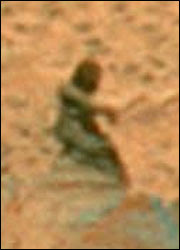
Now, I present to you as I finally end this incredibly long and fairly useless post. We have misnamed Mars. Sure the planet is red. But it is really a nice planet. It is full of happy smiling places. Hmmm. What Roman deity would be better? Some happy guy hanging around Mt. Olympus and all...  Dionysus?  He's already got his own asteroid.

Man.  Did I really write a post with Nermal in it?

Thursday, October 30, 2008

A Guessing Game - or - Asteroids for Dirty Minded People

Whenever I here the word asteroids, I immediately think of Vacation when the two boys are talking and the Griswald boy asks if the kid has asteroids (referring to that great 80s video game for you young'uns out there) and the other kid says, no but his dad does and it keeps him on the john for hours.

O.K. , asteroids found around earth's orbit are called Apollo asteroids.  They are so named because the first one found was called Apollo in keeping with the trend of naming space objects after mythology figures.  I'm guessing that since Apollo flies around the earth, the name was picked (yikes, I'm talking like Yoda here).    Other asteroids were soon found and named Bacchus, Sisyphus, Icarus, and the like.  Can you guess which Greek figure (no it is not the four already mentioned) was used to name this asteroid?  A big No-prize to the person who gets it first.  I'll reveal the answer in a week or so.

Wednesday, October 29, 2008

The Devil's beating his wife

Did you ever hear that statement?  Supposedly it is a saying common with the Dutch and U.S. Southerners (because we have so much in common).  That's what I was always told when it is raining by the sun is shining.  Who is this wife?  More on that later.

In the 1800s, it was predicted that we have not one, but two moons.  This was based on the gravitational pull and the moon's orbit.  I'm not going to get into the science of it because 1. it is boring and 2. I don't really understand it.

The problem is that nobody had ever seen this moon.  It was theorized that this moon is always in the new phase - like our moon is when we can't see it.  This dark moon was named after the first woman in Christian mythology.  Lilith.

That's right, Eve was wife number two.  According to Christian legend, Lilith was  first and fell victim to the serpent's apple deal.  It seems that you women just can't keep away from temptation (mythologically and biblically speaking, of course - not my views...).  Anyway, unlike Lilith, she enjoyed being smarter than Adam so much that she didn't share her find with him.  Instead she spent her time hanging out with the serpent.  When God remade woman (Eve), He wouldn't let Lilith hang out around there and corrupt them.  So the devil took her in as married her.  Now when he beats her, we can see it!

But we can't see the moon named after her.  The search was on but no one found it.  O.K., so there is no moon, but what about the gravitational irregularity.  Well, to explain that, we now believe that we have what is called Trojan satellites.  Trojan because it is something that has snuck inside the orbit of our moon, much like the Trojan horse was snuck into Troy.  The satellites in this case are dust particles so disperse as not to be visible (although some astronomers have claimed to have seen them).  They are called the Kordylewski Clouds (a completely unmythical and therefore boring name).

Friday, October 17, 2008

The Knights Who Say . . . "Neith?"


O.K., if you have a knight with a lisp, it might come out that way.  Neith.  The next planet in our solar system.  You've heard of it, right?

Well, 1672,an astronomer noticed a small companion close to Venus and saw it again 14 years later.  Soon, other astronomers saw it too.  One guy saw it going across the sun with Venus.  So then the question was raised, planet or moon?

In 1766, Father Hell (I kid you not, his real name) declared that it was an optical illusion. In 1884, it was declared to be a planet.  They named it Neith.  According to one source it was after the mysterious goddess, whose veil no mortal raised.  See the cleverness here?  No mortal can see her, and we have a hard time seeing her.  Ha, ha.

Later, people changed their mind and said, oh, it was just a faint star that got int he way.  I mean come on, there are billions of them, no one can keep track of all of them.  The problem is that it doesn't explain the siting in front of the sun.

To make matters more mysterious, a VERY famous astronomer in the late 1800s (Barnard) shows a faint star in his recordings near Venus.  He was one of the most accurate star listers in history; however, there is no star in that vicinity.  A moon, perhaps?  Neith?  An asteroid?  No one knows.   

Now, more about Neith the goddess - here is what God Checker has to say about this Egyptian goddess: 

The Great Weaver Goddess. Upset her and she threatens to unpick the woven Universe. Bits of it already seem a little threadbare. 

She was asked by BANEBDJETET to arbitrate in the fight for power between HORUS and SET. Thanks to her, HORUS was given supremacy and SET was given two compensatory Goddesses, ANAT and ASTARTE

When she gets in a bad mood, she becomes the War Goddess ANOUKE.

One problem, I didn't get any veil here.  In fact, other than the source who said the planet was named this because of her veil, I can't find anyone else saying it.  Now it is not uncommon to have conflicting myths, but to find only one mention of something is usually rare.  In fact, I did find this little picture and comment from http://www.swarthmore.edu/Humanities/pschmid1/essays/Nefertari/second.chamber.html  about how little Neith wears.  Apparently Neith didn't mind showing anyone anything:

Let’s talk fashion.

One of Nefertari's guardian-spirits, the goddess Neith, wears this stunning little number as she goes about her business helping Nefertari adjust to the new experience of being dead [to the left]. Nefertari’s not sure how to handle herself, or where to turn or what to do as she starts her journey to the afterlife. Just as important: what should she wear? But Neith is there to help. And not just by standing around; Ms. Neith looks fabulous. Can anyone imagine a more elegant dress---and also a sexier one---than this one? Topless, it lets the goddess’ heavenly breasts peek out amidst the shoulder straps.


I felt that I just couldn't improve on that since my fashion taste is lacking.

Sunday, October 12, 2008

I'm Your Venus

O.K., Once again I admit, my punacious titles could be better. Anyway, on we go through our solar system hitting the second? (more explanation on the question mark next solar system post) planet in our system. Venus. Named after the goddess of beauty for its beautiful star-like appearance in the sky. If you've ever marveled at a really really bright star in the early morning (even after the sun begins to come up) or early evening, you've probably have looked at Venus. Unfortunately, you can't see Venus right now.

Venus is weird in that a year on Venus is equal to 225 Earth years. Pretty cool that you would have your birthday more often. The weird thing is that a day on Venus (sunrise to sunrise) would last for 243 Earth days. That's right. Venus's day last longer than its year. See, it spins REALLY slow. As a result, it gets REALLY hot. During the daytime it gets up to 890° - that's hot enough to melt lead (for those of you who forgot your science class learning). Unlike Mercury, nighttime isn't much better because those clouds that are always present and reflect the sunlight to make this planet so bright and beautiful to us traps the heat in. we're talking global warming from Hades.

It rotates backwards (or as one of my students said, "how do we know that it's just not the only planet to spin in the right direction). Now, I assume time goes backwards here because if you remember the Christopher Reeve Superman movie, all he had to do to make time go backwards is fly around Earth backwards so many times that it began to spin backwards.

The Romans weren't the only one to name it after a deity of beauty:
  • Ishtar (Babylonian goddess of beauty)
  • Lucifer (Christian view of Satan as bright and morning star (but only as seen in the morning)
  • Inanna (Sumerian queen goddess - she can rain fire, pretty appropriate for the actual Venus)
  • The Aztecs and Mayans were scared of the light from Venus and made copious sacrifices when Venus was in the morning sky
Next - Venus doesn't have a moon...does it?

Tuesday, October 7, 2008

There's Something About Mercury

O.K., bad pun, but I figured that no one would get my "Crazy About a Mercury" allusion.

The first real planet in our solar system is Mercury.  It has the fastest orbit, which is why it was named after the quick messenger god. Currently we have a space probe up there looking at Mercury.  As you can see 
from the picture, there is a large swath of the planet we haven't photographed yet. 

But you can see Mercury - right now (well, right now if you happen to be reading this right before sunrise).  If you find yourself up and about around thirty minutes before sunrise, you should look east (where the sun will rise).  All through October Mercury is rising.  By October 20th it will be fairly high in the sky.  You won't be able to miss it, it should be the brightest thing in the east (well, until the sun comes up).

A few facts about Mercury:
  • It is the smallest planet (well now it is after they screwed Pluto over - more on that later in this series).
  • Because it goes around the sun almost as fast as it spins, there are three days every two years.
  • Mercury's thin atmosphere makes it blistering hot in the day time (but weirdly not the hottest planet in the system) and super cold in the nighttime despite it's closeness to the sun.
O.K., my five year son, Colby, wants to add something:
sfehssxhglrcb
wrecfvghhjiioopplkjhaqszxnm4uytk444ssggsdfgtageyeety

The Mercury of mythology is better known by his Greek name, Hermes.  He is not a major player despite being one of the big 12; however, he is present in a lot of stories.  He is the god of pretty much everything not already gobbled up by the other gods.  One great story that involves him is the story of Hermaphroditos, which was my very first post on this blog.

Winged Sandals has a nice little web site where they use an annoying little Hermes to tell you all about Greek mythology.


In other mythology, Mercury was associated with:

Nabu (ancient Babylon) - god of wisdom
Apollo (Greek) - god of archery - while the Greeks saw Hermes for the planet Mercury at night, they thought it was a different planet (or wandering star) when they saw it before sunrise and figured it must be Apollo.
Enki (Sumerians) - a creator god that not only created people, but created "holding hands" as well (I think that probably deserves a planet)
Thoth (Egypt) god of writing
Odin (Norse) god of wisdom, All Father

O.K., next entry we take a break from space and then get back to it!