Saturday, November 29, 2008

I Love Big Brother

Watch dogs, guardians, spies for the gods.  They are in every culture's mythology.  This is a fitting topic since Christmas is coming up and we know that Santa has the ultimate spying techniques (he knows when you are sleeping, he knows when you're awake).  So let's look at mythology what spies we can find.

My favorite is Ratatosk, the squirrel that runs up and down Yggdrasil, the Norse world tree.  This squirrel dutifully reports to all that will listen what he sees. 

Of course, you have Argos, the hundred eyed giant that never completely sleeps.  Some eyes
 sleep while others stay awake and watching.  Hera used him to what over Io (the poor girl turned into a cow so that Zeus could pretend he wasn't cheating on Hera).  Hermes did him in by playing music until all 100 eyes fell asleep and then chopped his head off. 

Mertseger of Egypt, was a guardian of the Valley of the Kings.  She lived nearby and watched for trespassers.  When she saw one, she would send out poisonous animals to sting and bite him.  If he repented, she would heal him of his wounds and send him on his way.

Back to the Norse, Odin had two ravens (Thought and Memory) that would fly around and report back to him what they saw.

But what about today?  O.K., anyone in a public high school knows that 1984 has come at least partially true.  Cameras are everywhere recording your every movement.  But we can do better than that.  Would you believe a camera system that can predict criminal behavior?  Yep, now science has passed mythology with a device that recognizes potentially criminalistic behavior, alerts a dispatcher who then in turns alerts nearby police to go to the area.  Don't believe me?  Google it!  Or just go to this site which is one of many on the web about it.

Wednesday, November 26, 2008

Let's Talk Turkey

O.K., for those of us in the States, the only thing on our mind is turkey.  Thanksgiving is coming up and it is time to overstuff ourselves with turkey, sweet potato casserole, mashed potatoes, green beans, pumpkin pie, and a whole bunch of other stuff.  But when it comes down to it, it is the turkey that we are all waiting for.

So, being a mythology fan and all, I wondered where turkey comes into mythology.  I don't remember Zeus ever turning himself into a turkey to snag some river nymph (but who knows with him).  So I did some searching.  Here is what I found:

The scientific (genus) name for turkey is Meleagris.  It comes from both the Latin for guinea bird and the Greek hero Meleager, the guy who led the charge along with Atalanta in the Caledonian Boar hunt.
In North America, the Native Americans and early Canadians believed that the turkey help create the world and showed humans how to grow corn and fight off evil spirits.  In fact the turkey in these myths is smarter than the owl and able to challenge the eagle in hand-to-hand  errr, wing-to-wing combat.

According to Hopi tradition, the male turkey is bald because it was the first animal to try and raise the sun to the sky, burning his head for his efforts.  I'm assuming the rooster won that one.

To the Aztecs, the god Tezcatipoca like to take the turkey form.  He is an evil god, except when he took his "jeweled turkey" embodiment and instead of evil, gave good luck to others.  He could also forgive sins in turkey form.

Me?  I just want to eat the thing.  Oh, and of course get my wish granted from pulling the wish bone.  Happy Thanksgiving to all of you, even those of you for whom this is just another day.

There is more about the turkey that can be found at this site.

Tuesday, November 25, 2008

Sexist, Chauvinistic Gods and the Women Who Love Them

Each moon of Jupiter is named after someone Jupiter was close to. There are at least 52 and may be more than 100. If you look through a telescope, you can see the first few of them They look just like little stars near Jupiter. Here are the first 16:

Io - changed by Jupiter into a cow to protect her from Juno's jealous wrath but tormented by Juno anyways since she suspected and sent a gadfly to sting her. She wandered all over the known world to get away from the fly. Eventually Jupiter gave in and released her.

Europa – o.k., here’s the situation. Jupiter turns himself into a bull. Europa says, “Hey, he’s hot!” Hmmmm…


Ganymede – beautiful young boy who was carried to Olympus by Jupiter disguised as an eagle to be the cup bearer to the gods.

Callisto – seduced by Jupiter, who changed her into a bear to protect her from Juno’s jealousy.


Amalthea – a naiad who nursed (it could have been her goat, sources are sketchy) the new-born Jupiter.

Himalia – a nymph who bore three sons of Zeus.

Elara – one of Jupiter’s hotties on the side. She gave birth to the giant Tityus

PasiphaĆ« – another one of these: Jupiter turns into a bull (although some myths do not have it being Jupiter) she thinks he’s all that and a bag of chips. She gives birth to the Minotaur as a result.


Sinope – Jupiter tried to hold hands with her and she was too clever for him so he granted her perpetual virginity.

Lysithea – also named Semele, mother of Bacchus by Jupiter.


Carme – an attendant of Artemis who fell for Jupiter and forsook Artemis’s man hating ways.

Ananke – goddess of fate and necessity and “friend with benefits” of Jupiter.


Leda – same story, take three: Jupiter turns into a swan. Leda says, “Hey! That’s one good looking bird and does things that shouldn’t be done with animals.

Thebe – getting tired of Greeks, this is an Egyptian. Io’s granddaughter and another hottie of Jupiter.


Adrastea – she helped to take care of little baby Jupiter.

Metis – a titanide who got pregnant after holding hands with Jupiter only to find out that her child will overthrow Jupiter. Jupiter, taking a lesson from his father, swallows her whole. She dissolves and the baby, Minerva, pops out of his head. Technically not Metis’s child since she no longer existed and thus no longer a threat to Jupiter. Everyone lives happily ever after. Well, not Metis, but…

O.K., that's enough about Jupiter's moons. I'm not going into all of them. Don't worry!

Monday, November 24, 2008

By Jove! Jupiter's Up Next

Now that we have passed the asteroid belt and left Ceres and Pallas behind, we move onto the big planets, starting with the biggest planet of all (in our solar system, at least), Jupiter.  

We know the Jupiter is the same god as Zeus, but lets look at him just as Jupiter.  What did the Romans think of him?  He was the son of Saturn and Ops (in the Greek Cronus and Rhea) and married his sister, Juno (hey, back then, you didn't have a lot to choose from and Juno did have those ox-like eyes that so turned him on).  He held multiple titles: Tonans (maker of thunder - a title that made the Norse associate him with Thor instead of Odin), Triumphator (sounds like a lame Terminator-type title but instead means (granter of triumph), Fulgar (thrower of lightning), and Invictus (protector - in battle not as much in daily life). 

Instead of spending all his time on Mt. Olympus, as Zeus does, Jupiter hung out a lot on Capitoline Hill (reminds me of the old School House Rocks cartoons - "I'm just a bill, on top of Capitol Hill) where his temple was.

Want to know the will of Jupiter?  Watch the birds.  Don't ask me what to look for, I just know that he reveals his will through the flight of birds.  Starting something new?  You better pray for his blessings (along with Janus, the two-faced (no literally, not making fun of him) god of gates and beginnings).  Oh, and wear white.  Jupiter just digs white.  He has white horses, priests wore white for him, white animals were sacrificed to him.

By Jove!  Jove means Jupiter.

You can see Jupiter now at sunset in the southwest (look toward where the sun just set and turn slightly to the left.  If you are in the Northern hemisphere, Jupiter will be chasing Venus (Venus is the brighter of the two).  If you are in the Southern hemisphere (which after installing the ClutrMap at the bottom of the page that some of you are), you can see Jupiter also in the south west, but Venus will not be gracing your sky.  Both are very bright and you can see why it would command the attention of the ancients.  What did the non-Roman ancients think when they saw this brilliant planet in their sky? 

Well, in Mesopotamia, they thought of it as Marduk, another chief god.

In Egypt (really ancient Egypt, before Ra and them came into popularity), they saw this planet as Ammon, the ram-headed chief god.

Hindu astrologers referred to it as Brihaspati, who was a religious teacher to the gods. 

I found some sources that tried to tie Jupiter, the planet, into Thor, but the Norse were very odd about their star names and I'm not sure that is entirely accurate.

Friday, November 21, 2008

I Feel Pretty Crappy About This

I'm all flushed because I forgot to celebrate World Toilet Day, which was November 19th.  I think it only fair that we take some time to look at the mythological implications of this.

To do so, I am going to give you the description of one of the three goddesses of toilets in Chinese mythology.  I found Zi Gu on God Checker, which I highly recommend as a web site for anyone who likes mythology.  

ZI-GU: Goddess of Toilets. 

One of the LAVATORY-LADIES, she started out as the beautiful wife of an actor during the Tang Dynasty. All was good until a high-ranking minister named Li-Jing fell in love with her, killed her husband, and took the unfortunate ZI-GU to be his mistress. 

His wife was insanely jealous. One day, while 
ZI-GU was taking what can only be described as a delicate pee, Li-Jing's wife leapt out from behind a pile of toilet paper and murdered her in cold blood. 

From that moment, Li-Jing's lavatory was haunted by the ghost of his ex-mistress. Strange spooky noises emanated from the closet at all hours, and even the most stout-hearted visitor would cross his legs and wait till he got home. 

When the news got out, Empress Wu, concerned for the kidneys of her top minister, blessed the ghost of 
ZI-GU and elevated her to Godly status. The haunting of the lavatory immediately ceased. (We believe this kind of exorcism is known as a Royal Flush.) 

The grateful spirit of 
ZI-GU ascended to Heaven and the toilet was safe to use once more. Life went back to normal. But Li-Jing's wife was never able to eat roughage again. 

As Goddess of Toilets, 
ZI-GU appears in the form of a beautiful contemplative woman, her lower body wrapped discreetly in clouds. This soothing image is a far cry from the typical Chinese hole in the ground, but that's mythology for you. 

Perhaps due to the thoughtful navel-gazing which takes place in the bathroom, 
ZI-GU is also known as the Goddess of Spirit Writing. She inspires mediums with messages from the Astral Plane. That's why mediums never take a newspaper into the bathroom. No need for a crystal ball. 

Incidentally, 
ZI-GU's favorite color is purple. This would seem to be the ideal choice when it comes to decorating the bathroom. However, as we know from experience, purple lavatory paper is almost impossible to get hold of.

Thursday, November 20, 2008

Does Size Matter?

Astronomically speaking . . . yes.  But more on that in a minute.

So, to the question I asked a while back - What planet comes after Mars?

Scientists are really smart people.  These guys (Titius and Bode to be exact) figured out that the planets exist in a proportional distance from each other.  They tried it out and sure enough it worked all the way until Saturn, which at the time was the last known planet.  Well, it worked until they got to Mar and Jupiter.  You see, there is no planet where there should be between Mars and Jupiter.  So people started looking harder.

Lo and behold.  The best way to find something is to look (and save time by looking int he last place since that is where things are usually found).  Someone found a planet right where it should be.  The problem was it was small.  Very smaller.  Much smaller than our moon.  They named it Ceres.  Then they found another, and another and another.  All of these were smaller than the first one.  Eventually scientists realized that in this orbit where a planet should be, there are millions of rocks (large rocks, mind you, not like a celestial gravel driveway or anything).  These became known as asteroids.  They are really hard to find because they look like dim stars and you have to record all the stars in that area over a period of time and see which one is moving.

Back to Ceres.  This asteroid is round and behaves like a planet.  So people wanted to call it a planet, but since it is too small and just the big dog of the asteroids, nobody did it and now it is too late (we'll talk about why when we hit Pluto (for which I am still angry about (look! I am so angry that I am over parenthesizing! (Wow!  spell check says that parenthesizing is a word - who knew!)))).

This is a mythology blog, so let's get to it.  Ceres, the goddess of corn and agriculture is the obvious name for this planet/dwarf planet/ asteroid since it is a rock with no atmosphere, barren of all life.  Oh well...


But hey!  I shouldn't be too hard on the scientists.  They were trying to keep the Roman names going - did I say Roman?  The second largest asteroid was named Pallas, another Greek name :(

There are no other myth names for Ceres since it is not noticeable with the naked eye.

Tuesday, November 18, 2008

Two Things

One, check out The Pomegranate Blog for a poem about Icarus.  It is translated and written in its original language.

Two, I just learned something today and wanted to pass it on.  I know that you, I'm sure, have already known this for some time, but, well, it is new to me.  I've always thought Pandora had a box.  You know, Pandora's box - right?  Well, the Greek poet Hesiodus said she had a pithos, this is (so I'm told since I don't speak Greek, maybe Ailia can help me since she can) a jar for storing grain.  Everyone went along for years saying Pandora's jar until Erasmus published Adagia, in which he translated it as box.  Since he was so widely read at the time, 
the use of box became more common than jar.

I don't know what is worse, the fact that I, while never claiming to be a scholar, didn't know this or from the fact that I learned it from a children's book 
my son checked out of his school library.

Monday, November 17, 2008

A Brief Interlude

I'll tell you later what planet comes after Mars (not Jupiter). Today, however, I'm going to give you a book excerpt. I picked up The Last Kingdom. Being the English teacher that I am, I was unable to resist a book about the years of King Alfred the Great. The book is written by Bernard Cornwell. It might get a review here later, but for now I'm only on page 60.


Anyway, the book is historical fiction, so it is not about mythology; however, it does show a lot about how the mythological beliefs of the Danes played out in their day to day lives. The part I give you here is from the mind of a young boy who is English and Christian, but around enough people who remember the days of Woden.


Even at ten years old I understood that a god Christian should not boast of being spawned by a pagan god, but I also liked the idea of being a god's descendant and Ealdwulf often told me tales of Woden, how he had rewarded our people by giving us the land we called England, and how he had once thrown a war spear clear around the moon, and how his shield could darken the midsummer sky, and how he could reap all the corn in the world with one stroke of his great sword. I liked those tales. They were better than my stepmother's stories of Culbert's miracles. Christians, it seemed to me, were forever weeping and I did not think Woden's worshippers cried much.

Friday, November 14, 2008

Fear Factor


In an older Batman comic (Knightfall to be exact), the Scarecrow (the lame villian in the Batman Begins movie) claimed that there was a god for everything, except fear and he was going to be that god of fear.

You see, this is why comic books are not good resources. Granted, comic like to drag myths into their stories, but this time they are completely wrong.

Mr. Scarecrow, meet Deimos, the Greek god of fear. His name even means fear. He and his brother, Phobos, the god of terror, hang out with their daddy, Ares. They are completely Greek since Ares needs them to install fear. The Romans never really took to them since Mars an install fear all on his on.


It seems, though, that the Scarecrow is not the only one not up to date on his mythology. Asaph Hall, the astronomer that found the moons of Mars decided to name them after Mars's sons, Phobos and Deimos, even if they are not really sons of Mars (by the way, grammatically speaking, you are supposed to make Mars possessive by adding the 's but to make Zeus possessive you only add the ' which makes for punctuational fun for everyone - Strunk and White (kings of grammar style) suggest you just say the ___ of Mars or the ___ of Zeus in order to avoid confusion all around). I guess we can forgive him since it does make sense to have fear and terror hanging around the god of war.


In the picture, Phobos is the big one. They are really two little asteroids that got caught in Mars's orbit (oops, the orbit of Mars).

Next we continue our tour of the solar system and find out what planet comes after Mars (and it is not Jupiter...) - oh and happy birthday to me!

Thursday, November 13, 2008

Tag, I'm It

Ailia tagged me over at Paleothea, so now I'm it in a brutal game of meme. If you've never heard of meme, here are the rules:

1. Link you the person who tagged you. Done! (see above)
2. Post the rules on your blog. Done! (see here)
3. Write six random things about yourself.

O.K.
1.
I have a fantastic wife and two little boys one 9 and one 5 (who contributed his thoughts to this blog a few weeks ago)
2. I love watching Survivor and The Amazing Race
3. I still hold the record in the 500 freestyle at my high school set back in 1985 (yes, I'm OLD)
4. I love looking at stars through my telescope
5. I have two dogs, a golden retriever named Orry (short for Aurora) and a black lab puppy named Krypto (after Superman's dog)
6. My students named me Lord Alford instead of Mr. Alford when I was trying to teach Romeo and Juliet and they couldn't understand why people were called Lord Capulet and Lord Montague. The name stuck and students came in the next year calling me that. I attached it to this blog because originally it was going to be used only for class, but now it just looks like I'm full of myself.

4. Tag six people at the end of your post and then link them.
I'll tag Dani Harper at Romancing the Wolf, Carmen Forward at the Pomegranate Blog, Carla at the English Teacher's Blog, and here I'm breaking the rules (that's right Ailia, I'm male so I feel I can break whatever rule I wish) because most of the other blogs I read are either not very personal like Cake Wrecks or 1000 Awesome Things (for that matter, Carla at Web English Teacher is a national site more than a personal site, but I read her everyday, so I'll risk annoying her), or else Ailia already tagged them like Mahud, Aquila ka Hecate, and A. Venefica.

5. Let each person know they’ve been tagged and leave comment on to their blog. Done!

6. Let the tagger know when your entry is up.

Next Post - FEAR or, why comic books aren't great sources for mythological information.

Tuesday, November 11, 2008

The Face(s) of War

I've actually been slowly working on this post for a week now. I'm determined to get it done today and move on! It's just been one of those weeks.

As we continue our journey through our solar system (having already past Vulcan, Venus, Neith, Lilith, and Apollo asteroids) we finally come to Mars. Mars is known as the red planet and it does not take too much imagination to put red with blood and blood with war and viola! You get the name Mars after, of course, the Roman god of war.

You might be thinking, O.K., we know Mars is red because we have telescopes. Why did they call it that way back when? Well, you can see Mars from your backyard from time to time. It appears as a bright star and has a distinctive red tint to it. In areas that have less light pollution the redness sticks out a bit. We can't see it right now because it is hanging out with Mercury and the sun, but I'll let you know when we can.

In Egypt referred to Mars as Horus the Red (Horus being the slayer of Set - yeah the evil Democrat we talked about earlier). The name Cairo comes from an Arabic word for Mars. In Hindu it is named after Indra, the king of the gods. The Babylonians called it Nergal, after their god of war. Nergal, by the way, is mentioned in the bible in 2 Kings 17:30. Don't confuse him with Nermal, the world's cutest kitten.


Those things are great and all, but what really interests me is not Mars the war god (by the way, I think it is funny that as Mars the Romans have him pretty tough and as Ares the Greeks have him as a wimp). What interests me more is the faces of Mars.


I'm sure you've seen this one. It comes from a 1976 photo taken by Viking Orbiter I. The face you see here is over 2 miles long and looks a lot like some Egyptian pharaoh. Could it be????? Well, unfortunately for all conspirators out there, a picture taken later in 2001 of the same rock showed that it was only shadows. Unless, of course, NASA is hiding something...


That is not the only face to show. I said faces. That is plural meaning more than one. Try this one out:
This was actually used in the Watchmen comic book. It exists and is real. Then there is this:
I know, it looks more like something my kids did at the beach, but it is a highly sophisticated space photograph. And last, but not least, here is the proof that NASA lies to us, a picture of Big Foot on Mars!
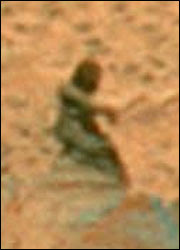
Now, I present to you as I finally end this incredibly long and fairly useless post. We have misnamed Mars. Sure the planet is red. But it is really a nice planet. It is full of happy smiling places. Hmmm. What Roman deity would be better? Some happy guy hanging around Mt. Olympus and all...  Dionysus?  He's already got his own asteroid.

Man.  Did I really write a post with Nermal in it?

Thursday, November 6, 2008

Wordle

I ran across this interesting website which will take words and randomly position them for you.  Probably works great with poetry but I stuck in the Olympian names and thought I show it here to bide time until I could finish the Mars post.


 If you try one, send it to me so I can see it.You can try it yourself at http://www.wordlenet.

Tuesday, November 4, 2008

Election Day Mythology


O.K., election day show down. I have my own opinion of who should win and you have yours. To Bubo's Blog, however, it doesn't matter what we think. We want to judge this race on a mythical basis. This blog will Google both "donkey mythology" and "elephant mythology" and from looking only on the first twenty results, will take the best mythology reference to each and compare. Which ever animal has the best mythological results will have their party endorsed by Bubo's Blog, regardless of my personal preference. To be sincere, I am writing this portion of the blog BEFORE checking Google - just to be fair and balanced.


And our contenders are:


Ganesha - Hindu god of success and destroyer of evils and obstacles. He is the son of Shiva and probably the most recognizable image of Hinduism. He is also worshipped as the god of education, knowledge, wisdom, and wealth.

Possible election fraud here since normally we stay away from Christianity, Hinduism, Islam, Judaism, or any other still practiced religion - however, there were no other connection to elephant and mythology other than in Hinduism in the first 20 pages on Google and precedent has been established for us to delve into these religions before, so election officials have decided to take it.


and


Set - The Egyptian god of chaos, war, storms, and the desert.  This nasty guy Not only killed Osiris, but cut him into little pieces and hid them.  He was a Pharaoh, but nobody liked him and
 eventually was replaced by Horus.  He has a donkey face, or at least part donkey face and tends to be mixed with many animals showing his chaotic side.  His evil nature is a force to be reckoned with and he has already shown he will do what it takes to get the position of power he craves.


The results:

Set leads a powerful campaign, pulling out all the stops and mud slinging.  At every turn, Ganesha seems to escape the brunt of the attack, but cannot seem to overcome this obstacle set (no pun intended) before him.  Ganesha struggles with running a clean campaign based on his views of education and the economy.  He is especially sidelined when allegation of fraud are brought up by Set due to Ganesha's status as really be mythology or not.  However, he continues to fight on, barely winning supreme court cases allowing him to run, only to be defeated in a landslide on election day.  Set lives it up high at his victory party for about an hour, until he is arrested for having ballot boxes stuffed.  Ganesha proves that he is indeed the lord of overcoming obstacles and moves on to be the first Hindu president.

Agree?  Disagree?  Mythologically speaking of course, not on your own political views.