Friday, July 25, 2008

Pluto's New Buddy

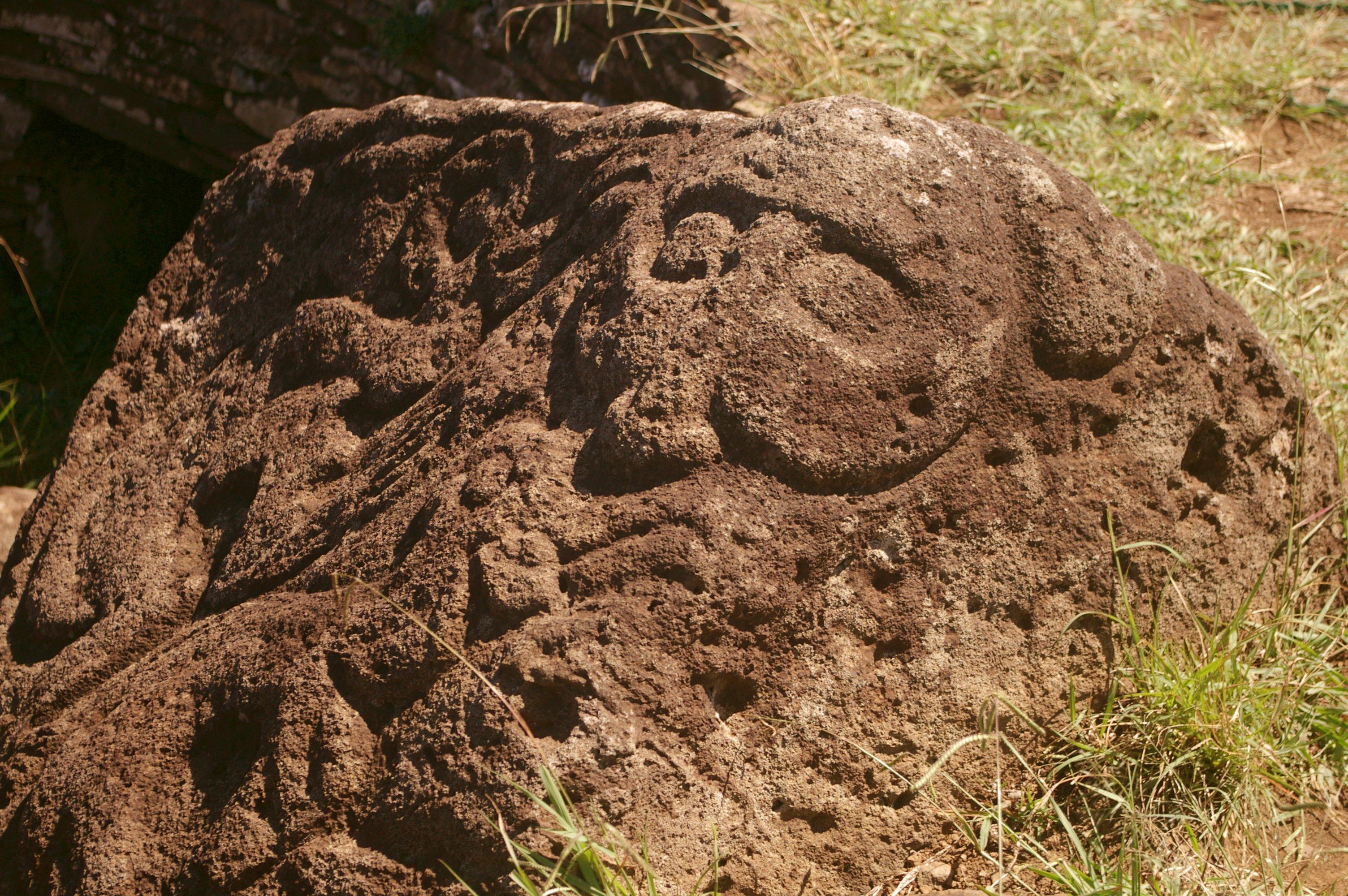
The picture to our right is Makemake, the creation god of Easter Island. Here is what godchecker.com has to say:
Top God of the Rapanui people of Easter Island. The all-powerful creator and benefactor, he was the only God they cared about, apart from a little AKU-AKU ancestor worship. The MOAI statues littering the island may once have been dedicated to him, but nothing is certain as it all went horribly wrong and now no-one remembers a thing. There was a terrible civil war in which the MOAI were cast down, and a new cult sprang up which introduced TANGATA-MANU, the Bird-Man. MAKE-MAKE must have been pretty cross, as the fortunes of the Rapanui subsequently went from bad to worse.


The picture to our left is also Makemake. Makemake is the third plutiod to be named. A plutoid is a dwarf planet beyond Neptune. There are four dwarf planets named: Ceres (in the asteroid belt between Mars and Jupiter), Pluto (still ticked off about being demoted from planet status), Eris (the dwarf planet that caused all of the hullabaloo and got Pluto demoted (aptly named after the goddess of discord)), and now Makemake.
This dwarf planet was originally named 2005 FY9 (or, by his discoverer, Easter Bunny since it was found near Easter). When the IAU, International Astronomical Union, decided to give it a name, Mike Brown (the aforementioned discoverer) was given the chance to name it. He took his task seriously and decided to keep in the tradition of naming space objects after mythological figures. Now we are more familiar with the Roman named objects, but there are several other mythologies used in space as well, just for smaller stuff. In fact, the moons or Uranus are mostly named after Shakespeare characters, not mythology at all.
Mike Brown said, "Makemake's surface is covered with large amounts of almost pure methane ice, which is scientifically fascinating, but really not easily relatable to terrestrial mythology. Suddenly, it dawned on me: the island of Rapa Nui [Easter Island]. Why hadn't I thought of this before? I wasn't familiar with the mythology of the island so I had to look it up, and I found Makemake, the chief god, the creator of humanity, and the god of fertility. I am partial to fertility gods. Eris, Makemake, and 2003 EL61 were all discovered as my wife was 3-6 months pregnant with our daughter. I have the distinct memory of feeling this fertile abundance pouring out of the entire universe. Makemake was part of that."
This is not the first space object that Mike Brown has named and he really wanted not only to name it after a mythological figure but to also make it fit. He considered naming it something with the oracle at Delphi. His rationale was that there is a theory that the trance like state of the oracles may have come from some gas seeping out of the rocks nearby. He said, "this theme was just dumb."

Since it was already called Easter Bunny, he thought about Eostre, the goddess for whom Easter has its name (possibly). Unfortunately, there is already an asteroid with that name.
Seizing on the bunny aspect of Easter Bunny, he looked at Native American mythology. There are lots of rabbit gods in Native American mythology. Unfortunately they are mostly named Hare or Big Rabbit. He said that he considered an Algonquin rabbit trickster god named Manabozho, but, "I must admit, perhaps superficially, that the 'Bozo' part at the end didn’t appeal to me."

Finally he came up with Makemake and there we go. IF you want to read Mike Brown's full account of naming his planets, go to: http://www.mikebrownsplanets.com/2008/07/whats-in-name-part-2.html. If you want to read the whole Astronomy article, go here: http://www.astronomy.com/asy/default.aspx?c=a&id=7220
I'm taking a break from the blog for about two weeks while I go on vacation (beach and Disney). If I can, I'll post some more. While I'm gone, hit the poll about who you think would win in an all out divine grudge match between Zeus, Thor, Ra, or Lugh. All are their heavy hitters in their mythology. If I don't get stuck on "It's a Small World," I'll see you in a fortnight!

Sunday, July 20, 2008

Mythical Salmon

I ran across a rather different headline today: "Wild Salmon and Celtic Mythology Link." Now, if that headline grabs your attention, first, re-evaluate your life, second go to this link: http://www.pressandjournal.co.uk/Article.aspx/743667?UserKey=0

Well, after I re-evaluated my life, I looked at the article which was about a museum exhibit of paintings about salmon and had this to say about the Celts and their rather smelly aquatic friends: "The paintings feature vivid colours to portray their vitality and importance within Celtic mythology, where they were primarily associated with wisdom and prophesy."

That's it. I figure the writer was not too interested in Celtic mythology and just wanted to get this story posted and, as they say in newspaper lingo, put the story to bed (actually, having never worked in a newspaper, I don't know if they really say that, but I have heard it on movies).

So, what connection is there to salmon and Celtic mythology? Glad you asked:
1. Cu Chulainn, hero extraordinaire, has the famed salmon leap that always him to jump over enemy walls (I like Cu Chulainn, it takes 150 naked women to snap him out of his battle rage).
2. Fintan was a Salmon that fed off the hazelnuts that fall off the tree of life or some other mystical tree if you are reading Celtic mythology pre-Christian Ireland). This fish is also called Brandan and is supposedly the oldest animal in the world.
3. Boann, a water goddess (Celtic deities tend to be A __ goddess rather than THE ___ goddess) went to the Well of Inspiration (thus called because of the divine hazlenuts that fell into it, wherein lived Fintan, now the salmon of wisdom. She somehow knocked over the well and started a new river.
4. Finn MacCool is Celtic hero who caught Fintan from this river. What do you do when you catch the salmon of wisdom? You cook it, of course. This isn't Japanese mythology, after all. While cooking the fish, a bubble popped up. Finn pops the bubble and burns his thumb. When he sucks on his thumb, he gained the wisdom of the fish. Whenever he needs wisdom, he just sucks his thumb.
5. In an early King Arthur tale, Culhwch find a salmon that might possibly be the same Fintan, but this one is called the Salmon of Llyn Llyw. This salmon leads them to find Mabon, a divine child. Some versions have Culhwch riding on the back of the salmon (that's one big fish!).
6. To stop his daughter from marrying Frech, Ailill throws her engagement thumb ring into a river. Later Frech catches a salmon and in the salmon is, you guessed it, the ring.

O.K., it seems that most of the salmon stories might actually be the same fish. If Fintan inspires you so, then you too can show your devotion. That's right, for a mere $31 (plus shipping) you can own your very own tote bag that has Fintan pictured on it. I know you're dying to get one (don't be the only one at your job, on your street, at your school without one!) so here is the link: http://www.zazzle.com/celtic_salmon_of_knowledge_bag-149197255556725852.

Man. After all of this, I could really go for some seafood...

Tuesday, July 15, 2008

The Birth of Venus


Most people are familiar with The Birth of Venus by Botticelli.

The picture is simple in its mythological terms. Obviously we are taking the birth of Venus as she sprang form the ocean after Cronus did the unthinkable to his father, the resulting body part hitting the ocean and springing forth life. On the left side, we see the winds, Zephyr and Aura, who are using their power to either raise the shell or, as every adolescent male tends to think, to blow her hair off the important parts. The idea is that they are showing the chaos before the titans took over.

This picture shows her as being modest, which doesn't usually fit her character in myths. Botticelli did this on purpose because of the Aphrodite of Cnidus, also called Venus Pudica (the Modest Venus), a statue of Aphrodite sculpted in 4 BC. It was discovered about the same time this was painted. The statue shows her covering her groin with her right hand. To add to this modesty, one of the Graces rushes forth to cover her with a cape.

The land is covered with Laurel and Myrtle trees. Laurel is symbolic of peace and victory (maybe the victory of love over all or the victory of Cronus over Uranus). Myrtle is symbolic of love and is often used with Venus.


This is another Birth of Venus by Alexandre Cabanel 1863.


The Birth of Venus by William-Adolphe Bouguereau, 1879.


No modesty here. I'm liable to get my blog suspended for this one.


Of course, I did not get on this topic because of culture or any other redeemable quality. I saw this picture by Derek Thompson from Futurama that made me think of it.


And last, but not least, the Mad Magazine version.


Of course, there are several others and I may have missed your favorite. If you have a favorite Birth of Venus, leave a link to where we can see it.

Friday, July 11, 2008

Rainbows

Occasionally I Google mythology in the news category and see what pops up. Most of the time it is not about actual mythology but someone invoking the word to mean "not true." Sometimes, like today, it yields something neat.

In an Indian newspaper, we have a story about rainbows. It tells mythological origins of the rainbow in Greek (Iris), Japanese (Niji), Norse (Bifrost), German, Hindu, Greenland, Croatia, the Bible, and others. It did leave out Hawaiian, which states that a rainbow is formed every time a god comes to earth. If you have ever been to Hawaii, then you know that the Hawaiian gods really rack up their frequent flyer points.

It also tells a few facts about how rainbows are made. Personally, I have the distinction of having seen an upside down rainbow once as a kid (where everybody told me I was making it up or didn't see it correctly) and once as an adult. There is something about a rainbow that makes most people stop and look, no matter what their age is. To me, it is the ultimate proof that God, gods, divine being, ______ (insert your choice here) exist(s). Chance cannot* be that creative. I mean come on, we are lucky enough to be on this planet that happen to be in the right spot and happen to have life form on it AND we get rainbows too? Come on, even for a mythology teacher, that's got to be a bit hard to swallow! :)

I'm not going to plagiarize the story. One because I'm an English teacher and we all took oaths to track down plagiarist and hang them up to dry. Two because the story is well done. Short and simple. You can read it here: http://living.oneindia.in/expressions/factual-expressions/2008/myths-facts-rainbow-070708.html.


* See "cannot" is listed as one word. From this point on, make sure you spell it that way (told you I was an English teacher).

Wednesday, July 9, 2008

What Shampoo Does Medusa Use?

NOTE - This post has been revisited.  See the NEW and IMPROVED version of this post!

Tired of dry hair and spilt ends? Dandruff getting you down? Oily hair your problem? Nobody understands bad hair days like Medusa. That's why she uses Thermasilk with heat activated moisturizers! Check out this commercial.

It's called Thermasilk Party and it features either Hephaestus or Apollo (the god's on fire, so probably Hephaestus) doing the tango with Medusa, who uses Thermasilk, so the heat from his body (and the occasional lightning bolts from Zeus) activates the moisturizers and !poof! we have hair all under control. See how many other Greek figures you can find. It's a Where's Waldo for mythology lovers.
For those of you that are keen on special effects and how it is done, you'll want to check out this site about how the commercial was made: http://www.boardsmag.com/articles/magazine/20000901/specialreportfx5.html?print=yes

Sunday, July 6, 2008

Virgin Births

A recent jaunt through Google led me to think out virgin births. What was this thing that sparked that kind of thinking so far away from Christmas? I'll tell you later. But for now, I want to look at the virgin birth in mythology.

Obviously we have the birth of Jesus, but as we are talking about mythology (and I've already made it clear in this blog that I don't think active religions should be classified as mythology), I want to explore the others:

In Egypt, Mut-em-ua, the virgin Queen of Egypt, gave birth to the Pharaoh Amenkept III. This process is involved the god Kneph holding an ankh to her mouth and is represented on the walls of the temple of Luxor.

In Greece, Zeus gives birth all by himself to Athena (O.K., he cheated by swallowing the pregnant titanide Metis and letting her dissolve inside him before having Athena pop from his head, but hey! it still counts!)

Back to Egypt, some accounts of Ra's birth say tha Net is is mother and that he has no father.

A Phrygian god names Attis was born of Nana, a virgin who put an almond up to her bosom to get pregnant.

Perseus was born of a virgin, since his mother never "held hands," but rather was exposed to a golden shower of rain that was really Zeus in disguise. Maybe another cheat there...

Mithras (a god worshipped in the Roman empire pre-Christ, was said to have a virgin mommy (some stories forego the mom altogether and say he sprang from a rock). His birthday was on December 25th.

Krishna has a virgin mother. Buddha too was born of a virgin.

Hertha, an ancient Teutonic goddess was a virgin who gave birth to a son.

There are others. I think one of the interesting things about the research into the virgin birht, was that although I was trying to look for examples in mythology, I could not help but run into so many web sites that only exist to show their hatred for the virgin birth of Jesus story. Mary was called all sorts of things in these sites and none of them good. Nevertheless, this research was spawned (HA! Get it! Spawned!) by a summer swim team.

I help coach a summer league team of 4 - 18 year olds who have the mascot the Hammerheads. While I was cheering them on, I began to wonder what a female hammerhead was called. I figured when we cheered the girls on we could use that name (I know, I am a nerd - this team has existed for a few decades and nobody else had ever wondered that). As I began to look it up, the one story I kept coming across was from 2007 where a virgin hammerhead gave birth. That got my attention. Maybe we have a potential savior for all shark kind here. It appears that female hammerheads store up sperm for just in case they can't find a male when they need him. In this case, however, the female hammerhead (in captivity) never had contact with a male in the first place. So how did this happen? It made me smile to see all those other websites spewing out such hate saying that it was impossible for such a thing to happen, yet here we are.

By the way, a female shark is called . . . a female. Very original.