Showing posts with label unknown gods. Show all posts

Thursday, January 3, 2013

Repost: Festival of Sleep Day!


January Third is a day of holidays.  It is Throw Out Fruitcake Day, Humiliation Day, and my favorite, Festival of Sleep Day.  So in celebration, we'll look briefly at Hypnos, the Greek god of sleep.

He lives in Erebos.  Since Erebos is the land of perpetual darkness, he can catch a few extra winks.  He catches a ride on his mom's (Nyx) dress and floats around during night (much like Isabella's boyfriend).  He has a twin brother, Thanatos.  Thanatos is the incarnation of the peaceful death.  He has some regular brothers that make up the Oneiroi, or dreams.

To make people fall asleep, he has a variety of instruments, on being a branch that drips water from the river Lethe.  Another is an upside down torch, although I'm not altogether certain how that symbolizes sleep.

I don't know about you, but I've already taken my nap and celebrated this special day.  *yawn* Maybe we can stretch this one out to the twelve days of Sleep Festival....

Tuesday, March 2, 2010

Stop # 4 - Aeolus

Aeolus is a minor god that helped Odysseus out by giving him a bag of bad winds so that only good winds would blow him home.  Of course, he didn't tell his men who assumed it was gold and when he fell asleep (right as they approached Ithaca) they opened the bag, sending them way off course.

Who is this guy?  Most of us probably don't know that much about him, so this will be a Tribute to the Unknown God posting (actually, it will be a 5 for 1 deal). Well, he has a floating island close to Sicily for one. The gods used him to release the winds for bad storms. His nickname is Hippotades (the controller of horses) since the Greeks saw winds as horse-shaped spirits. 

His dad is Poseidon (makes sense since Poseidon is also credited with stormy seas) and the father of the four winds:

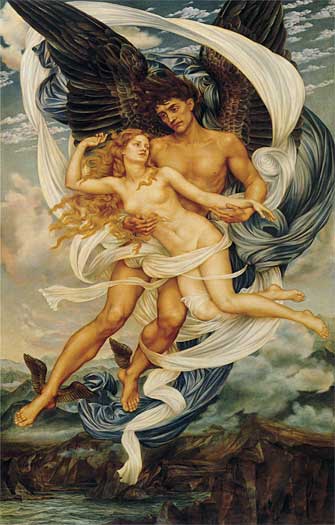
Boreas - The North Wind - he has serpent tails for feet and likes to hang out at Mt. Haemus (where Typhoon likes to hang out).  He usually uses a conch to blow his winds and has golden/amber colored wings.  He is very strong and tends to be destructive. He even shipwrecked Hercules once.  He also disguised himself as a horse and got some fillies great with child (Why?  I don't know).  Of course people would remark that these horses are as swift as the wind.  His most famous story is the kidnapping of Oreithyia.  He did this because her parents delayed in answering his marriage proposal.  They bore two children, both boys, who were a part of th Argonauts.

Eurus - The East Wind - He also has wings but is a bit more gentle.  He is known for bringing rains, so he is usually seen with an upside down vase pouring out water.

Notus - The South Wind - known for his fog and mists, shepherd and sailors didn't really like him.  However, he was revered by thieves.

Zephyrus - The West Wind -  Probably the best known of the four winds.  Cupid used him to bring Psyche to his palace.  He known for being gentle.  Despite that, one of his more famous stories is about violence.  Zephyr fell in love with a young man named Hyacinthus.  When he saw Hyacinthus playing discus with Apollo, he got so jealous that he caught the discus in mid air and sent it back at him.  The discus hit Hyacinthus on the head and killed him.  Where his blood hit the ground, the hyacinth flower bloomed.  He too fathered horses.  Two of these horses were ridden by Achilles.  They could talk.  Rumor has it that they are the ancestors of the famous Mr. Ed of TV fame.


Next stop - Odysseus and his men get invited to dinner!

Wednesday, December 23, 2009

Hippos and Pregnant Women

Before I get any more mean looks from my female readers out there, I'm not making the comparison between hippopotami and pregnant women.  I know that pregnant women feel self conscious but I think in reality the only person who looks at a pregnant woman and thinks fat is the pregnant woman herself.  To everyone else she just looks beautiful.

Now with my disclaimer out of the way, let's see if I can stick my foot into my mouth.  Taweret is the Egyptian goddess of pregnancy and childbirth.  Her name means, "the great female one." 

What does she look like?  She is usually shown with the head of a crocodile (although sometimes with the head of a hippo), the body of a hippo with large breasts and bountiful belly, and the feet of a lion.  The crocodile and lion parts are to show her fierceness in protecting pregnant mothers and children.

Why a hippopotamus?  Well it was not because of the insensitivity of the Egyptians.  You need to remember that the Egyptians would have to deal with hippos on a regular basis.  They soon learned that male hippopotami are aggressive (in fact, the hippo bite is considered the deadliest, not because of the number of people killed by the hippos, but rather because when they do bite, it is nearly always fatal).  due to their territorial nature.  Female hippopotami are nicer.  They are usually very calm and do not seem to care about territory.  They are aggressive, however, if anything threatens their children.  So eventually, the female hippo came to be seen as a good mother. The Egyptians then thought it obvious that a motherhood goddess would be a hippopotamus. 

Want to see her?  Well, you can, as long as you live in the Northern hemisphere.  Go outside at night and look north (face the sunset and turn right.  You will probably be able to see the Little Dipper (looks like a spoon with the handle bent backward) with little problem unless your horizon has a lot of trees.  That is Taweret, or at least her back.  The other stars around the Little Dipper are also part of her.  This shows the importance of Taweret to the Egyptians since being this constellation means she will always be in the night sky.  Those of you who live in the southern hemisphere are just out of luck.  Taweret doesn't like you.

Despite this importance, Taweret does not have any temples to her.  She does have a lot of knick-knacks like pillows and bed headboards with her decorations.  It seems that she is best worshipped as a part of the home.

The TV show Lost shows a statue of her in season 5, episode 16.  I have never seen the show, but maybe some of you have.

Without going into details, we all know that a male must be involved with her.  In older myths she liked Apep, but eventually the myths said that she liked to hang out with Bes, a dwarf god of pleasure (oh yeah).

I was drawn to look for goddesses of pregnancy since my wife just let me know that she is, well, to keep with the season, great with child (of course I think she is great all the time).  This will be our third child and I'm pretty excited.  So expect to see a few more baby related posts in the next several months!  Once we know if it will be a girl or a boy, I'll have to have a baby naming contest here on the blog (I'm sure my wife will be pleased to name our child after a great mythological character...).

Wednesday, October 28, 2009

Bobbing for Apples

O.K., so I'm surfing around on the Internet, totally shirking my duties, and I run across this Roman mythology connection to Halloween.  It seems that there was a holiday called Feralia that was designed to give peace to the dead.  Sacrifices were made in honor of them, prayers said, and all that good stuff.  The problem is that it was celebrated on the 21st of February.  Hmmm....

I dug a little further and found that Pope Boniface IV replaced this celebration with All Saint's Day.  This was observed on the 13th of May.  O.K., getting closer....

Then, Pope Gregory III moved the date to November 1st (I suppose to coincide with Samhain). Alright.  Now we're talking.  But, you may say (out loud if you are a little strange), why did you title this entry "Bobbing for Apples?"  Well (I might say back to you if you are a bit schizophrenic), it comes from me typing Feralia into Google.

It seems that there was another Roman festival that might have been pulled into the Halloween celebration the same way as Feralia.  This festival was to the goddess of fruit trees, Pomona.  She was associated heavily with apples.  The theory is that her festival on August 13th was pulled into the Samhain makeover and all that is left now is the bobbing for apples part.

So, dress up your kids or yourself, your dog or cat even, and have fun this Halloween.  Just make sure that while you are engaged in all that tricking and treating stuff that you take some time out to bob for an apple or two and remember poor Pomona, who lost her holiday.  I fear it is pretty much gone forever, as I do not foresee a It's the Great Apple, Charlie Brown coming anytime soon.

By the way, the goddess Pomona does live on and can be found at her blog, Goddess of Pomona, although she very much downplays her deitic roots.

Monday, September 14, 2009

Chi-Chi-Chia


"I pity the fool that doesn't water my Chia!"


Before you think I have completely lost it, I do have a connection between the wonderful Chia pet and mythology.

For the Aztecs and Mayans, chia pets may not have been the rage, but chia seeds were. They were cultivated for consumption as far back as 3400 BC. The Aztec warriors used it in their rituals and it was believed that a tablespoon of seeds would sustain a warrior for 24 hours. It was so much a part of their mythology that the Spanish conquistadors banned it.

There is even a South American goddess named Chia, although I think that is just a coincidence. Doesn't matter to me. This goddess would give any Greek goddess a run for her money. Here is what God Checker says about her:

CHIA: Evil Moon Goddess and wife ofBOCHICA.

Identified with HUITACA, the drunken Goddess of Bad Behavior, she is believed to have caused a number of floods — possibly in association withCHIBCHACHUM.
As punishment for her crimes against humanity, she was transformed into the Moon. Or — if you prefer a different version of the legend — an owl. Or possibly the owl in the moon, or an owl that moons.
She was known to be on friendly terms with CHIBCHACHUM, but the rumor mill has long since closed down.


Now I was able to beat the Obscure Goddess Online Dictionary on this one, but that is only because they have their hands full with other cultures and are smart enough not to tackle Meso-American cultures. Unfortunately, Goddess-a-Day has beaten me to it with this entry:

Huitaca is the Chibcha Goddess of the moon, pleasure, and drunkenness. Also known as Chia or Chie, she advised her followers to live a life of happiness and joy, much to the chagrin of her husband, Bochica, God of laws and morals. Tired of having Huitaca undo all his hard work, Bochica turned her into an owl.

I think we need to petition the Chia Pet company to stop avoiding mythological chia ideas. I mean, come on, there are Obama Chias, Mr. T Chias,Shrek Chias, Homer Simpson Chias, and every type of everyday normal animal chias, but no Cerberus Chia, or Pegasus Chia. How ridiculous is that? Just imagine, if we can get the goddess Chia into the mainstream, then maybe we could have a Chia Chia!

You know, that idea is right up there with my CuChulainn action figure...

I'll leave you with this. I found this picture on the internet from Guatemala. Evidently, someone has taken my idea of mythological chia and has stopped at no expense to make sure it is down right - after all, if it is worth doing, it is worth overdoing (which I think is from Mythbusters... - another myth connection!)


Wednesday, May 27, 2009

Another Tribute to an Unknown God

Today is my 14th anniversary.  I wanted to get my wife a cool gift and consulted the traditional gift list for the 14th anniversary.  This posed a problem since the traditional gift is ivory, which is illegal to trade in.  Apparently elephants can't meet the demand and so now I'm stuck on what to give my wife...

Anyway, I looked up on GodChecker.com "anniversary."  This is what I got:

HE-BO: God of the Yellow River. 


The Yellow River (Huang He) is China's second longest river and probably the muddiest river in the world. Over a billion tonnes of silt and sediment flow through it each year, giving the Huang He its distinctive yellow color and making it a poor choice for washing your socks in. 

Although the Great 
DA-YU took care of the Great Flood, the Yellow River was still prone to flooding. So an enthusiastic mortal named HE-BO tied heavy rocks to his back and jumped into the water as a supreme sacrifice. 

For his pains he was granted immortality and promoted to God of the Yellow River. 

Following his example, it became the custom to throw a young virgin into the river on the anniversary of his death. This practice appears to have died out. 

Now, that was interesting and all, but it gave a deathly pall to the whole thing and wasn't quite what I was hoping for.  I don't know what I expected.  I was hoping to find some Baltic goddess that goes by the name Anniversia who has some ritual for wedding anniversaries or something.  Alas, it was not to be.

It did remind of the old joke:  Did you read the book Yellow River by I. P. Freely?

Childish, I know.  Did you really expect any different?

Sunday, February 22, 2009

Tribute the the Unknown God

We here at Bubo's Blog have had a tribute to the unknown god entry before.  Basically, it is a review of a lesser known deity (or at least lesser known me).  I have had ten entries (something I need to correct) and of them all, my favorite is "Eating Hearts and Reading Comic Books."  Today, however, I really want to know more about the actual unknown god, or at least how the Athenians saw him.

According to the story, Athens was bothered by a plague.  They couldn't figure out why this problem was, well, plaguing them so.  One chap by the name of Epimenides came up with a good idea.  Rather than spend a lot of time sacrificing to the wrong god and only getting the one that is upset with them even madder, he suggested letting a lot of sheep loose and whenever they stopped and laid down, sacrifice it to the god of the area they laid down in (apparently the Greeks had most of their little corners and niches dedicated to this god or that goddess).  The idea was working great, except a few sheep kept laying down in areas that were not dedicated to any particular deity.  Epimenides suggested that they build an altar and dedicate it to the unknown god.  He said that this must a pretty powerful god and wouldn't mind that they didn't know his name.  This covered all their bases.  The plague stopped and you had one very happy unknown god and several dead sheep.

The Greeks called this unknown god, Agnostos Theos.  This practice wasn't limited to Athens. The altar you see here is a Roman altar dedicated to an unknown god.  The Romans were very concerned about offending any deities, which is one reason that they were pretty liberal in accepting other cultures' gods and goddesses as the empire spread.  In fact, the Romans were happy to have people worshipping their own gods after they got taken over - the only catch is that they needed to worship the established Roman ones too.  This is one of the reasons that the Jews and early Christians had so much conflict with the Roman Empire.  If you believe in one and only one god, a god that has specifically said, "Hey!  No worshipCheck Spellingping other gods and goddesses," then you can see where the problem comes in.  

In fact, in Acts chapter 17, Paul (about 50 years later) is walking down the streets in Athens and comes across one of these altars and comments on it to the people of the area, suggesting that the unknown god they are missing is really the one and only God.

I guess it is a good point by the Athenians.  Ignorance my be bliss, but when you neglect a god because of it, then that's just ignorance.

Friday, November 21, 2008

I Feel Pretty Crappy About This

I'm all flushed because I forgot to celebrate World Toilet Day, which was November 19th.  I think it only fair that we take some time to look at the mythological implications of this.

To do so, I am going to give you the description of one of the three goddesses of toilets in Chinese mythology.  I found Zi Gu on God Checker, which I highly recommend as a web site for anyone who likes mythology.  

ZI-GU: Goddess of Toilets. 

One of the LAVATORY-LADIES, she started out as the beautiful wife of an actor during the Tang Dynasty. All was good until a high-ranking minister named Li-Jing fell in love with her, killed her husband, and took the unfortunate ZI-GU to be his mistress. 

His wife was insanely jealous. One day, while 
ZI-GU was taking what can only be described as a delicate pee, Li-Jing's wife leapt out from behind a pile of toilet paper and murdered her in cold blood. 

From that moment, Li-Jing's lavatory was haunted by the ghost of his ex-mistress. Strange spooky noises emanated from the closet at all hours, and even the most stout-hearted visitor would cross his legs and wait till he got home. 

When the news got out, Empress Wu, concerned for the kidneys of her top minister, blessed the ghost of 
ZI-GU and elevated her to Godly status. The haunting of the lavatory immediately ceased. (We believe this kind of exorcism is known as a Royal Flush.) 

The grateful spirit of 
ZI-GU ascended to Heaven and the toilet was safe to use once more. Life went back to normal. But Li-Jing's wife was never able to eat roughage again. 

As Goddess of Toilets, 
ZI-GU appears in the form of a beautiful contemplative woman, her lower body wrapped discreetly in clouds. This soothing image is a far cry from the typical Chinese hole in the ground, but that's mythology for you. 

Perhaps due to the thoughtful navel-gazing which takes place in the bathroom, 
ZI-GU is also known as the Goddess of Spirit Writing. She inspires mediums with messages from the Astral Plane. That's why mediums never take a newspaper into the bathroom. No need for a crystal ball. 

Incidentally, 
ZI-GU's favorite color is purple. This would seem to be the ideal choice when it comes to decorating the bathroom. However, as we know from experience, purple lavatory paper is almost impossible to get hold of.

Saturday, September 6, 2008

Hurricanes

I don't know where you are reading this, but I'm writing this on the eastern side of the country. Hurricanes occasionally come by here and just this morning we had Hurricane Hanna (well, technically it was a tropical storm by the time it hit us) come through. Behind it is Ike and behind that is Josephine. So I began to wonder about hurricanes and mythology. Once I waded through all the sites by angry people on Katrina, I found the following story from Babylonian mythology:

In the beginning was water. From this came Apsu (sweet water) and Tiamat (salt water - not to be confused with Tiamat, the five headed dragon from the old Dungeons and Dragons cartoon). They do what all brother and sister gods tend to do when left to their own devices (I'm talking about holding hands) and gave birth to Mummu (waves), Lakhmu (a big serpent), and Lakhamu (another big serpent).

The serpents held hands and gave birth to the heavens and earth. And these held hands to make all the great gods. All these baby gods made so much ruckus that Apsu and Tiamat decided that maybe it would be best to destroy them all and get a good night's sleep (come on, if you are a parent, you can say that the thought hasn't crossed your mind at least once...).
One of the great gods was Ea, the all knowing. So being all knowing and all, he found out about the plan. He captured Apsu and Mummu. This thoroughly pissed off Tiamat who then created an army of freaks to teach Ea and his siblings a lesson.

Ea, being all knowing and all, realizes that things don't look so good and tries to get some of the other gods to get off their lazy rear ends and fight. They are all scared. All except Marduk.

Marduk said he would beat Tiamat if he would become the supreme god. The agreed, held a big feast, had lots of fun and gave him a scepter and a throne.
Marduk went to battle armed with arrows, lightning, wind, a net, and a HURRICANE (thus the connection here). Tiamat came riding a storm being pulled by four huge horses. They fight.
When Marduk caught her in his net, Tiamat tries to swallow him whole, but as she opened her mouth, Marduk shoved the hurricane in it. There she sat, all bloated and full of gas, and Marduk shot her in the belly. I don't know if she popped like a balloon, but she died.
Moment of silence.
Marduk then caught her army of freaks and threw them into the underworld. Tiamat's body was then cut up and used to create part of the world in which we live. He created us from the blood of Kingu, her general. All the gods, awed by his strength and power (and perhaps feeling a little guilty) gave him their powers, making him top dog of Babylonian gods.

Friday, July 25, 2008

Pluto's New Buddy

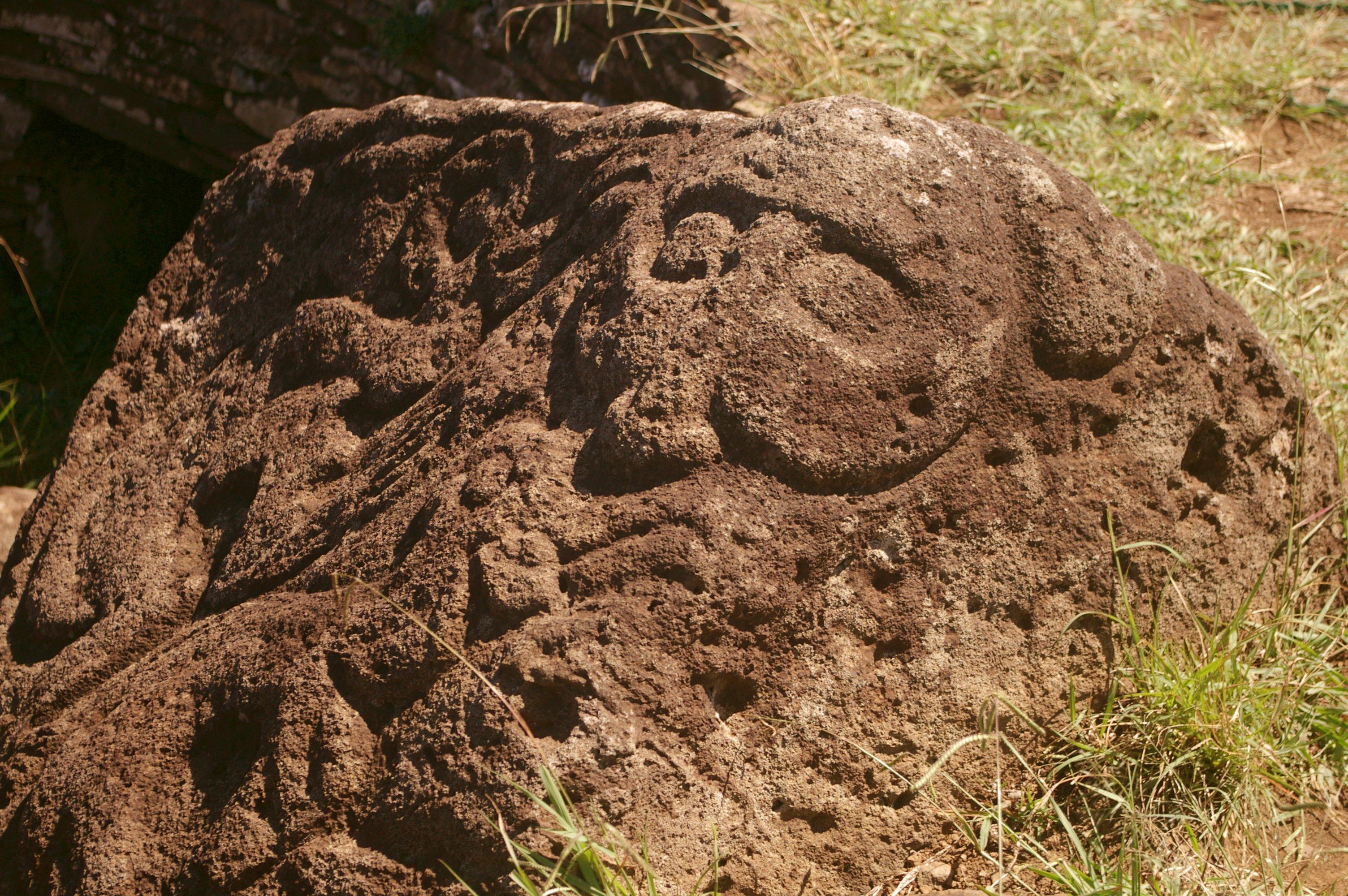
The picture to our right is Makemake, the creation god of Easter Island. Here is what godchecker.com has to say:
Top God of the Rapanui people of Easter Island. The all-powerful creator and benefactor, he was the only God they cared about, apart from a little AKU-AKU ancestor worship. The MOAI statues littering the island may once have been dedicated to him, but nothing is certain as it all went horribly wrong and now no-one remembers a thing. There was a terrible civil war in which the MOAI were cast down, and a new cult sprang up which introduced TANGATA-MANU, the Bird-Man. MAKE-MAKE must have been pretty cross, as the fortunes of the Rapanui subsequently went from bad to worse.


The picture to our left is also Makemake. Makemake is the third plutiod to be named. A plutoid is a dwarf planet beyond Neptune. There are four dwarf planets named: Ceres (in the asteroid belt between Mars and Jupiter), Pluto (still ticked off about being demoted from planet status), Eris (the dwarf planet that caused all of the hullabaloo and got Pluto demoted (aptly named after the goddess of discord)), and now Makemake.
This dwarf planet was originally named 2005 FY9 (or, by his discoverer, Easter Bunny since it was found near Easter). When the IAU, International Astronomical Union, decided to give it a name, Mike Brown (the aforementioned discoverer) was given the chance to name it. He took his task seriously and decided to keep in the tradition of naming space objects after mythological figures. Now we are more familiar with the Roman named objects, but there are several other mythologies used in space as well, just for smaller stuff. In fact, the moons or Uranus are mostly named after Shakespeare characters, not mythology at all.
Mike Brown said, "Makemake's surface is covered with large amounts of almost pure methane ice, which is scientifically fascinating, but really not easily relatable to terrestrial mythology. Suddenly, it dawned on me: the island of Rapa Nui [Easter Island]. Why hadn't I thought of this before? I wasn't familiar with the mythology of the island so I had to look it up, and I found Makemake, the chief god, the creator of humanity, and the god of fertility. I am partial to fertility gods. Eris, Makemake, and 2003 EL61 were all discovered as my wife was 3-6 months pregnant with our daughter. I have the distinct memory of feeling this fertile abundance pouring out of the entire universe. Makemake was part of that."
This is not the first space object that Mike Brown has named and he really wanted not only to name it after a mythological figure but to also make it fit. He considered naming it something with the oracle at Delphi. His rationale was that there is a theory that the trance like state of the oracles may have come from some gas seeping out of the rocks nearby. He said, "this theme was just dumb."

Since it was already called Easter Bunny, he thought about Eostre, the goddess for whom Easter has its name (possibly). Unfortunately, there is already an asteroid with that name.
Seizing on the bunny aspect of Easter Bunny, he looked at Native American mythology. There are lots of rabbit gods in Native American mythology. Unfortunately they are mostly named Hare or Big Rabbit. He said that he considered an Algonquin rabbit trickster god named Manabozho, but, "I must admit, perhaps superficially, that the 'Bozo' part at the end didn’t appeal to me."

Finally he came up with Makemake and there we go. IF you want to read Mike Brown's full account of naming his planets, go to: http://www.mikebrownsplanets.com/2008/07/whats-in-name-part-2.html. If you want to read the whole Astronomy article, go here: http://www.astronomy.com/asy/default.aspx?c=a&id=7220
I'm taking a break from the blog for about two weeks while I go on vacation (beach and Disney). If I can, I'll post some more. While I'm gone, hit the poll about who you think would win in an all out divine grudge match between Zeus, Thor, Ra, or Lugh. All are their heavy hitters in their mythology. If I don't get stuck on "It's a Small World," I'll see you in a fortnight!

Sunday, July 6, 2008

Virgin Births

A recent jaunt through Google led me to think out virgin births. What was this thing that sparked that kind of thinking so far away from Christmas? I'll tell you later. But for now, I want to look at the virgin birth in mythology.

Obviously we have the birth of Jesus, but as we are talking about mythology (and I've already made it clear in this blog that I don't think active religions should be classified as mythology), I want to explore the others:

In Egypt, Mut-em-ua, the virgin Queen of Egypt, gave birth to the Pharaoh Amenkept III. This process is involved the god Kneph holding an ankh to her mouth and is represented on the walls of the temple of Luxor.

In Greece, Zeus gives birth all by himself to Athena (O.K., he cheated by swallowing the pregnant titanide Metis and letting her dissolve inside him before having Athena pop from his head, but hey! it still counts!)

Back to Egypt, some accounts of Ra's birth say tha Net is is mother and that he has no father.

A Phrygian god names Attis was born of Nana, a virgin who put an almond up to her bosom to get pregnant.

Perseus was born of a virgin, since his mother never "held hands," but rather was exposed to a golden shower of rain that was really Zeus in disguise. Maybe another cheat there...

Mithras (a god worshipped in the Roman empire pre-Christ, was said to have a virgin mommy (some stories forego the mom altogether and say he sprang from a rock). His birthday was on December 25th.

Krishna has a virgin mother. Buddha too was born of a virgin.

Hertha, an ancient Teutonic goddess was a virgin who gave birth to a son.

There are others. I think one of the interesting things about the research into the virgin birht, was that although I was trying to look for examples in mythology, I could not help but run into so many web sites that only exist to show their hatred for the virgin birth of Jesus story. Mary was called all sorts of things in these sites and none of them good. Nevertheless, this research was spawned (HA! Get it! Spawned!) by a summer swim team.

I help coach a summer league team of 4 - 18 year olds who have the mascot the Hammerheads. While I was cheering them on, I began to wonder what a female hammerhead was called. I figured when we cheered the girls on we could use that name (I know, I am a nerd - this team has existed for a few decades and nobody else had ever wondered that). As I began to look it up, the one story I kept coming across was from 2007 where a virgin hammerhead gave birth. That got my attention. Maybe we have a potential savior for all shark kind here. It appears that female hammerheads store up sperm for just in case they can't find a male when they need him. In this case, however, the female hammerhead (in captivity) never had contact with a male in the first place. So how did this happen? It made me smile to see all those other websites spewing out such hate saying that it was impossible for such a thing to happen, yet here we are.

By the way, a female shark is called . . . a female. Very original.

Tuesday, June 3, 2008

Uncegila

This particular blog entry is a result of reading the Symbolic Meanings Blog "Symbolic Sevens entry (http://symbolic-meanings.com/2008/05/30/symbolic-seven-associations-with-the-number-seven/). In it A. Venefica challenges us to find other mythical and symbolic uses of the number seven. I found Uncegila. You can see a lovely rendition of this beast here.


What? You've never heard of Uncegila? Me neither until I started looking for sevens. You see, Uncegila is a terrible dragon from the Sioux Native American tribe, also known as the Lakota. We are perhaps a bit more familiar with some of their other stories involving the trickster spider known as Inktomi (yes, there is a web search engine named ofter this) and their white buffalo legend.


The story of Uncegila is a bit vague at times. It goes like this: Way back when the world was young, an evil witch was turned into the monster Uncegila. She is huge - as long as a hundred horses. Her snake like body is thicker than the biggest tree trunk and she is covered in glittering scales (actually mica). She has a curved horn coming out of her head. She was covered in spots and the only way to kill her was to shoot a magic arrow through the seven spot on her head. That is where she keeps her ice-cold crystal heart.


Heroes all tried to kill her, some to free the people of her wrath, but many to get her heart since it could grant you your heart desires.


Killing Uncegila, however, is not an easy task. Just looking at her will blind you. The next day you go insane. In four days you will die along with all the members of your family. She's got Medusa looking pretty good!

It so happened that two twin heroes came along to kill her. The youngest one was blind and did not fear the look of Uncegila. The older one agreed to take him to and from the place. In order to overcome his blindness, they went to an old ugly woman who could make arrows that always hit the target, no matter how bad your aim was. Her payment, one of them must sleep with her. The sighted brother could not bring himself to do this so he got his blind brother to do the deed. At least he was honest about it and told his blind brother what she looked like. But since this is mythology, she turns into a young beautiful woman. Seems she was cursed to live as a hag until a man came and made love to her.

Once they get to the place, they easily make short work of the dreaded monster - the blind twin shooting it and the other one cutting out the heart. The heart tells them a few things to do which they had been warned not to listen to and voila! They get their heart desires. The sun comes down and burns the body leaving the whole place a barren wasteland (the Badlands of Nebraska and the Dakotas) strewn with her bones. You can actually go there and see her bones today, although some so called "scientists" think they belong to dinosaurs. Ha!

The story doesn't end there. The twins are so tired of having everything they could desire, that they eventually destroy the heart and freed themselves of the curse of having what you want.

You can find this whole story at: http://pyramidmesa.netfirms.com/brulesioux18.html


Of course, Uncegila also has a comic book persona. Wolverine was the one who teamed up with a guy named Blind Owl. This was apparently early in his life and then later in Wolverine's very convoluted story lines was made into an alternate reality story.

Monday, May 19, 2008

Duality Synchroblog

This is a part of the May Synchroblog (where many bloggers write about the same theme) on Duality. See below for a list of other blogs that participated and check them out.


I jumped into this thing late, but wanted to find the right perspective for it. The answer literally fell into my lap. I am a big Raiders of the Lost Ark fan. I know it is loosely based on facts, but who cares. When I was kid, I wanted to be Indiana Jones. My name and state didn't have the right sound, though. North Carolina Alford just doesn't have the same ring to it. So I gave up a career in archeology and became a teacher instead.

Anyway, I'm at home watching my new DVD of Raiders and I can't help but wonder if the idol in the beginning scene has any basis in real life. There is a basis for the other stuff (the ark, the grail, the Sankara stones, the crystal skulls), so why not. Being a bit lacking in Hovitos mythology, I had to do some research.

What I found is that this idol (of a woman giving birth) is based on one of two Aztec fertility goddesses: Omecihuatl or Tlazolteotl. Both deal with duality and I'll handle the most frequently cited one first.


Omecihuatl is a dual deity. In fact her title is Lady of Duality (see, I told you this stuff fell into my lap). She is never seen by herself. She must have her brother/twin/life partner with her at all times. They represent the male/female duality which the world must have to survive. She and her brother (Omecutli) make up one deity known as Ometeotl. They preside over Omeyocan (Two Place), which is the thirteenth and highest heaven. Sometimes they are referred to as Tloque Nahuaque, which means "Owner of the Near and Far." Yes, there will be a test and you will need to know spelling.


You see here a real statue of the two. Ometeotl lived in a world of darkness. All she or he or they could see were the eyes of monsters glittering around them (like on Scooby Doo). They did what anyone would do stuck in a world of darkness with monster eyes all around. That's right. They poked the eyes. What happened was that the monsters became stars when their eyes were poked (wish I had known that as a kid). They got all into it and made a bunch of stars.


Finally, they found a monster that was all eyes and mouths and made the land and sea out of it. Since this is mythology and we have a brother/sister pair, what happens next is inevitable. They give birth to several children and completely ruin their school life by giving them impossible to pronounce names (Xipe Totec, Huitzilopochtil, Quetzalcoatl, Tezcatlipoca, and Coatlicue). Some of these go on to become a sun to light the world and end up destroying the world. After destroying the world four times, they decide to use a human to be the sun. We live in this world now and if we are not careful, this too shall end.


The biggest problem with this is that the statue looks nothing like the film statue and there were no temples to worship Omecihuatl. I only had other people's word on the Omechihuatl so I continued to research and found another goddess this child birthing idol could be. I found Tlazolteotl - the Two Faced Eater of Filth. Her statue looks a lot like the idol in the movie and is probably the one being referenced to despite the popularity of Omecihuatl. Tlazolteotl is a goddess of filth; however, she is also a goddess of forgiveness. This is how it works: when people are dying, she comes along and eats their filth thus cleansing them and granting them forgiveness. When she is not eating filth, she is usually seen giving birth in her role as a fertility goddess. She goes beyond duality - her roles are: goddess of fertility filth, sex, witches, carnal desires, earth, childbirth, prostitution, temptation, gambling, and purification. She is able to do all these things since she changes like the moon. In each stage she is a bit different.


Although this is supposed to be a synchroblog, as usual, I am out of synch and am a bit late. Thanks to A. Venefica for still letting me participate. Check out http://symbolic-meanings.com/2008/04/21/synchroblogging-symbolic-style/ for more blogs in this synchroblog.

Wednesday, May 7, 2008

Ammut

Ammut does not really fall into the realm of the unknown god that we give tribute to here at Bubo's Blog; however, if you are not familiar with Egyptian mythology, then she probably is.
Ammut goes by many names - Eater of Hearts is my favorite. Seems like the Egyptians had a thing about eating hearts (see http://bubosblog.blogspot.com/2008/04/eating-hearts-and-reading-comic-books.html for the Khonshu entry).
Without getting too involved in what happens to you when you die (that might be a good multi-part series for future entries), eventually you end up standing before three deities - Thoth, Ma'at, and Ammut. Ma'at is a large scale/goddess and weighs your heart against the feather of justice. Thoth records the weight of the hearts in his handy dandy notebook. If you heart weighs less than the feather - Yippee! it's time to enjoy the afterlife (which is pretty much like regular life). However, if your heart weighs more - which it probably won't since most of the wicked are weeded out by the different obstacles you encounter after death - then Ammut eats your heart, condemning you to non existence forever.

She has a crocodile head (no, not an alligator head - you can tell by the rounded snout), a leopard body, and legs of a hippo. Apparently, all those hearts goes straight to her thighs. (Some sources go with dog, lion, hippo).

Another name for her is the Dweller in Amenta. Amenta is west of the Nile where all people (or at least the important ones) were buried. The setting sun is a universal symbol for death. It is also the name for the underworld in some sources (most sources have it named Duat).
Sadly, there is no temple of Ammut. Thankfully is no feast day! Nobody worships her.She is to be feared and stand as a warning not to be wicked in life.

We'll end with a quote from Thoth that lucky dead Egyptians hear Thoth say:
The Osiris, whose word is true, is holy and righteous. He has not committed any sin, and he has done no evil against us. The devourer Ammut shall not be permitted to prevail over him.

Thursday, April 24, 2008

Eating Hearts and Reading Comic Books

Ah the moon! A thing of beauty, a time keeper, an eye in the sky, a regulator of tides, destroyer of enemies, eater of hearts, and giver of powers.


It is the last three that we talk about today. To do this, we need to go way, way, way back in Egyptian mythology to a god named Khonshu (with variant spellings like everything else in mythology). The Wanderer, Embracer, Pathfinder (no, not as in the movie of Vikings and Native Americans nor in the spirit of Natty Bumpoo), and Defender are just a few of his appellations.

Just as Artemis is associated with the moon and with wild animals, so is Khonshu, but he also has added benefits of helping both men and women with the act of conceiving little ancient Egyptians, healing, and cow fertility (which he is best at during the crescent moon). His weirdest name is King's Placenta. It was said that he protected Pharaohs by killing their enemies and taking their insides back to the Pharaoh. What they did with them, I don't know but eating them may have something to do with as he is also The One Who Lives on Hearts.

When shown in art, he has the head of a hawk or falcon with curved horns. The moon fits in those horns much like the sun fits on top of Ra's head.

Oh yeah, and he loves games, senet to be exact, and he is always gambling on it with Thoth. One would think that with the moon, eating of hearts, and pregnant heifers that he wouldn't have time for games, but I suspect he was also a good multi-tasker. Actually, the real reason is that people loved to worship him, just they didn't know quite what to do with him. The ancients had him as powerful, even helping with the creation, however, over time, he stopped eating hearts and lost his importance. That's how one goes from destroyer to cow fertility specialist.

Oh, and his temple is in Tanis - that's right, where Indiana Jones found the lost ark.

No matter what the Egyptians thought, he will always be one thing to me. The god of Moon Knight. Yes, you heard me, Moon Knight - the American mercenary turned Egyptian follower knock off of Batman (rich guy running around in tights fighting crime). In one run of his series his powers waxed and waned with the moon (the more full, the more powerful, and vice versa). He was my friend's favorite hero (second only to Spider-Man, of course) and had the distinction of have not just one secret identity, not two, but three secret identities. Of course, the destroyer part of Khonshu played a bigger part as I do not remember Moon Knight ever making cows fertile (but then, I didn't read all of the series).


Friday, March 14, 2008

Tribute to the Unknown Gods

Every so often on this blog we will have a tribute to a god that is not known very well. This one is dedicated to Priapus (also spelled Priapos):

If somebody asked him, "Who's your daddy?" He might would have a hard time answering. Many myths have different fathers for him. The candidates are Zeus, Hermes, Adonis, and Dionysus, with Dionysus being the most popular. Most of the stories have Aphrodite as the mother.

Whoever the father, Hera doesn't like Aphrodite being pregnant. If Zeus is the father, that's understandable. If it is one of the others, Hera is upset because either Aphrodite's promiscuity is detestable, or because this takes place after the famous beauty contest between the Hera, Athena, and Aphrodite (the one that started the Trojan war). Whatever the reason, Hera touches Aphrodite's belly before she gives birth and when she does, the baby is ugly and ill tempered. As a result, Aphrodite kicks him off Mt. Olympus.

A shepard finds this creature and at first is repulsed but then begins to see that the area around him is growing wildly. Flowers are blooming, grass is greener, trees are bearing fruit, and male and female animals are enjoying each others company in an intimate way. The shepard recognizes that this must be a fertility god and gives him the credit he is due. His cult of worship spreads.

People begin to put little statues of him in garden pots and place them in their garden (or bedroom *wink wink nod nod*) to make their flowers grow better or to have children. Now before you go and make one fore your garden, there is a reason that I have not put his picture up here. Here is what he is generally described as:
* He has a dwarfish body
* He has a huge head
* He has big hands and feet
* He has a particular piece of male anatomy that is so large that it curves backwards over his shoulder.

The only other myth about him other than his birth that I found was when he tried to rape Hestia. A donkey brayed loudly and alerted her he was coming so that she could get a way. Priapus beat up the donkey to get his aggression out.

I found on one web site that in some places as Christianity began to take over, many people were willing to give up all the gods but Priapus. They still made loaves of bread in the shape of, well, you know in a tribute to him. According to my source, the church O.K.ed it as long as the loaves were marked with three crosses and this may have been the start of hot cross buns.

Tribute over!